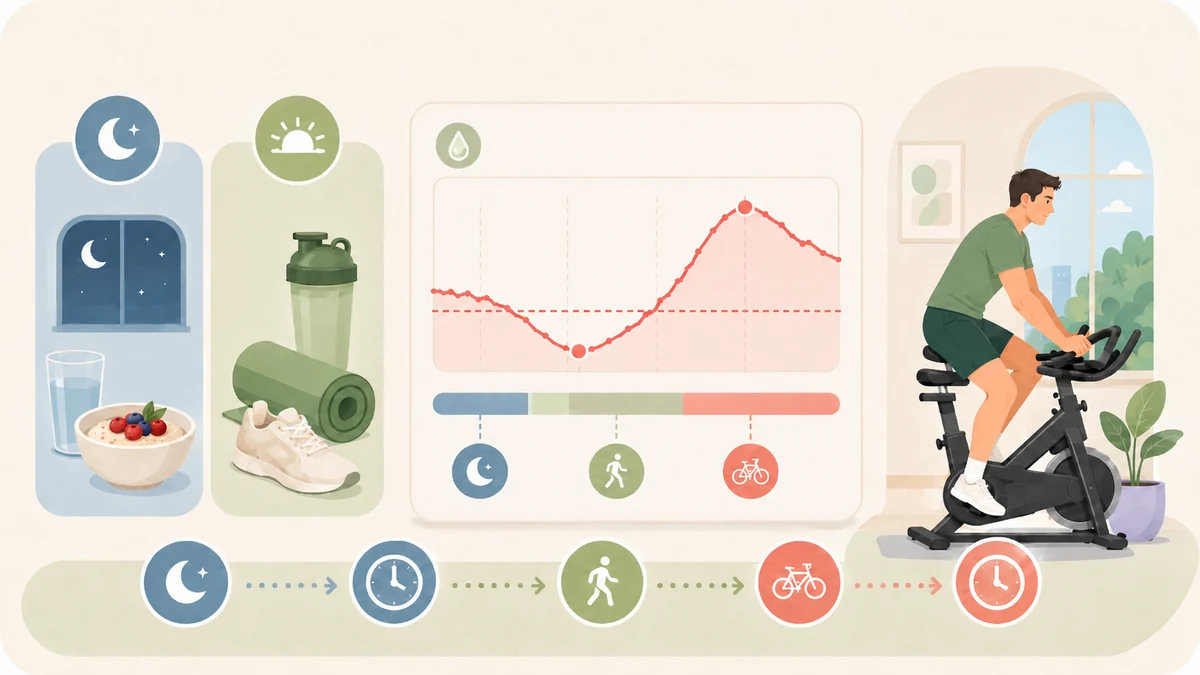
Wake time, food, appointments and exercise differ between these mornings. I therefore place them side by side without calculating an average “training effect”.
| Day | Context | first value | minimum | maximum | last value |
|---|---|---|---|---|---|
| 11.07. | ohne Morgentraining; spät aufgestanden, Termin, Einkauf, zwei Proteinbrötchen | 120 | 99 | 157 | 107 |
| 20.07. | 45 Min Low Impact um 09:03 | 121 | 114 | 140 | 128 |
| 21.07. | Iced Coffee 07:55, 45 Min Low Impact 08:55 | 119 | 113 | 145 | 124 |
| 22.07. | Iced Coffee 08:22, 45 Min Low Impact 09:10 | 105 | 102 | 142 | 128 |
What can reasonably be compared
The no-early-training day shows how wake time and a late breakfast change the starting context. Product drinks were also present on some ride mornings. These observations generate hypotheses but do not isolate the ride.
Next clean protocol
Seven mornings per condition, the same wake time, the same breakfast or fasting state, one defined ride and a fixed 06:00–12:00 window. Illness, overnight callouts and sensor changes will be excluded and documented separately.
Sources and methodological context
- American Diabetes Association, Standards of Care in Diabetes—2026: Physical activity and exercise
- Trefts et al., Exercise and the Regulation of Hepatic Metabolism
- Bergenstal et al., Glucose Management Indicator (GMI)
- Zaharieva et al., CGM lag during aerobic exercise
- Emhoff et al., Gluconeogenesis and hepatic glycogenolysis during exercise
The values in this article come from my own sensor (FreeStyle Libre 3) and are a single-case observation (n = 1) – they show a pattern in me, not a rule for you. Every statement is labelled as established, plausible or open, and proximity in time never counts as proof of a cause. How I handle time windows, sensor lag, influencing factors and approval is collected on one page. Read the methodology