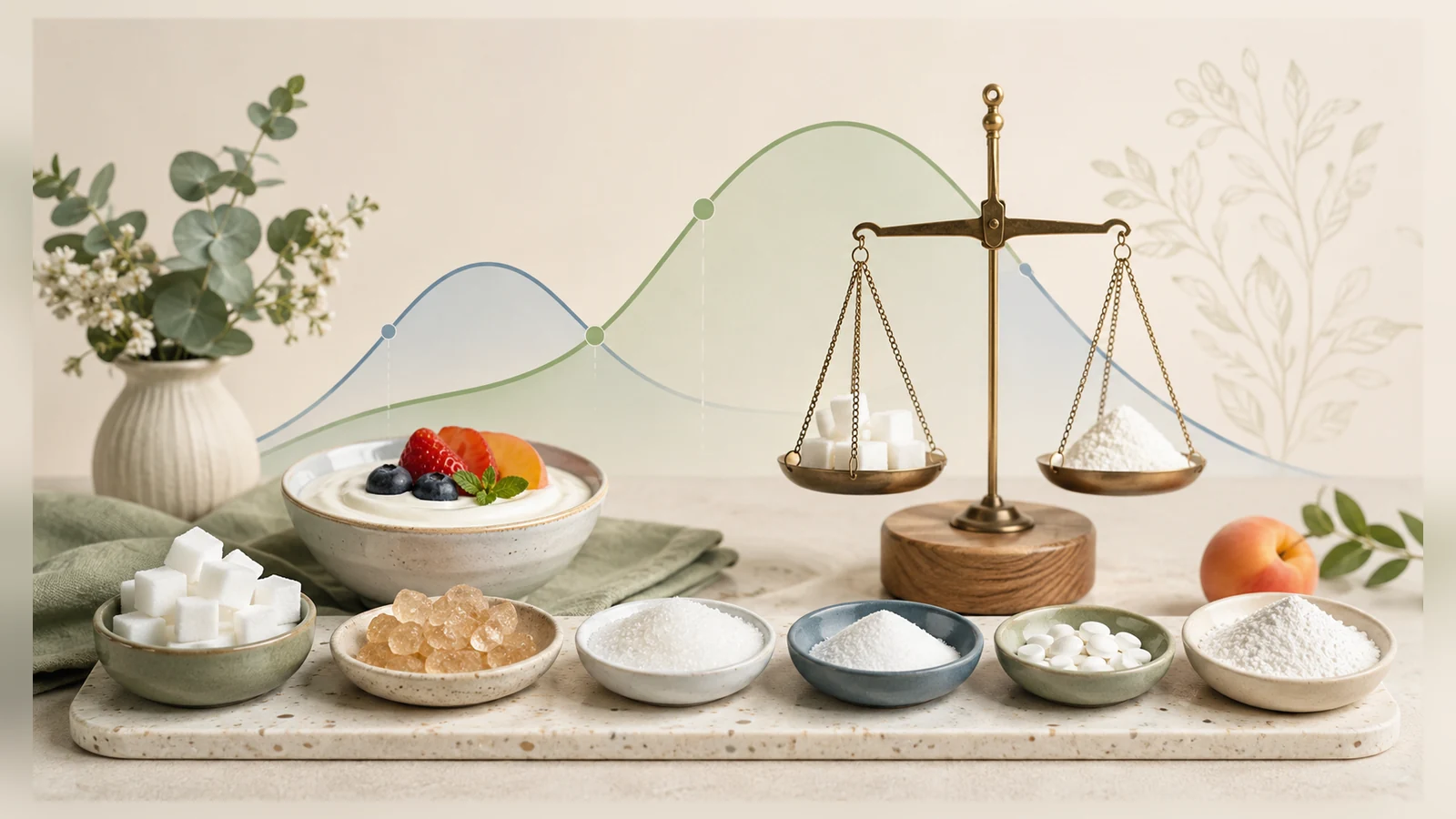
If you want to cut sugar, you quickly come across alternatives. They fall into two groups that differ in calories and effect on blood sugar.
The two groups
Sweeteners (e.g. aspartame, sucralose, saccharin, acesulfame-K, and the plant-based stevia and monk fruit) are very intensely sweet, practically calorie-free and barely raise blood sugar.1 Sugar alcohols or polyols (e.g. erythritol, xylitol, sorbitol, maltitol) provide few calories and have a small blood-sugar effect, but in larger amounts can cause digestive discomfort.12
What’s known about individual substances
Erythritol is barely metabolised by the body and mostly excreted unchanged: hence the very small blood-sugar and calorie effect.2 Xylitol has slightly more calories and a slightly larger effect. Stevia normally doesn’t raise blood sugar and doesn’t cause hypoglycaemia.2 Sugar alcohols also stimulate satiating gut hormones.2
Sugar alcohols in detail
Sugar alcohols (erythritol, xylitol, maltitol & co.) sweeten with a markedly smaller effect on blood sugar than sugar. Erythritol provides practically no calories and has hardly any blood-sugar effect, and is often better tolerated in large amounts than others. Xylitol has a low glycaemic effect but, important for households with a dog, is toxic to dogs. What they share: in larger amounts they can be laxative and cause bloating.
Newer studies have discussed a possible link between high erythritol blood levels and cardiovascular events. So far this is an observational signal, not proof: authorities still assess erythritol as approved. A reason for moderation, not a reason for panic.
Do sweeteners cause cravings?
A common worry: does sweetness without calories train the body to want “more”? the research on this is mixed and individual. For many people, sweeteners are a helpful stepping stone away from sugar; others notice that the desire for sweet things tends to remain. It’s best to observe for yourself what happens.
How individual sweeteners specifically affect blood sugar and gut flora in studies, I’ve broken down in detail in Sweeteners & blood sugar: the research.
Key takeaways
- Sweeteners: practically calorie- and blood-sugar-neutral, very intensely sweet.
- Sugar alcohols: few calories, small blood-sugar effect, mind digestion.
- Erythritol is barely metabolised; stevia normally doesn’t raise blood sugar.
- The WHO advises against sweeteners for weight control (2023).
- Research on individual substances is ongoing – occasionally yes, a free pass no.
Article ID: SWF-W-027Please quote this ID for corrections or additions.
Sources
Sources as of: 21 Jul 2026.
- Sweeteners and blood sugar: low/no glycaemic effect; overview of types. Reference. byramhealthcare.com (opens in a new window)
- Sugar alcohols/polyols: metabolism (erythritol), glycaemic effect, gut hormones, tolerance. Review. ncbi.nlm.nih.gov (opens in a new window)
- Overview of sweeteners; WHO 2023 advice on non-sugar sweeteners for weight control. Reference. goodrx.com (opens in a new window)