The short answer
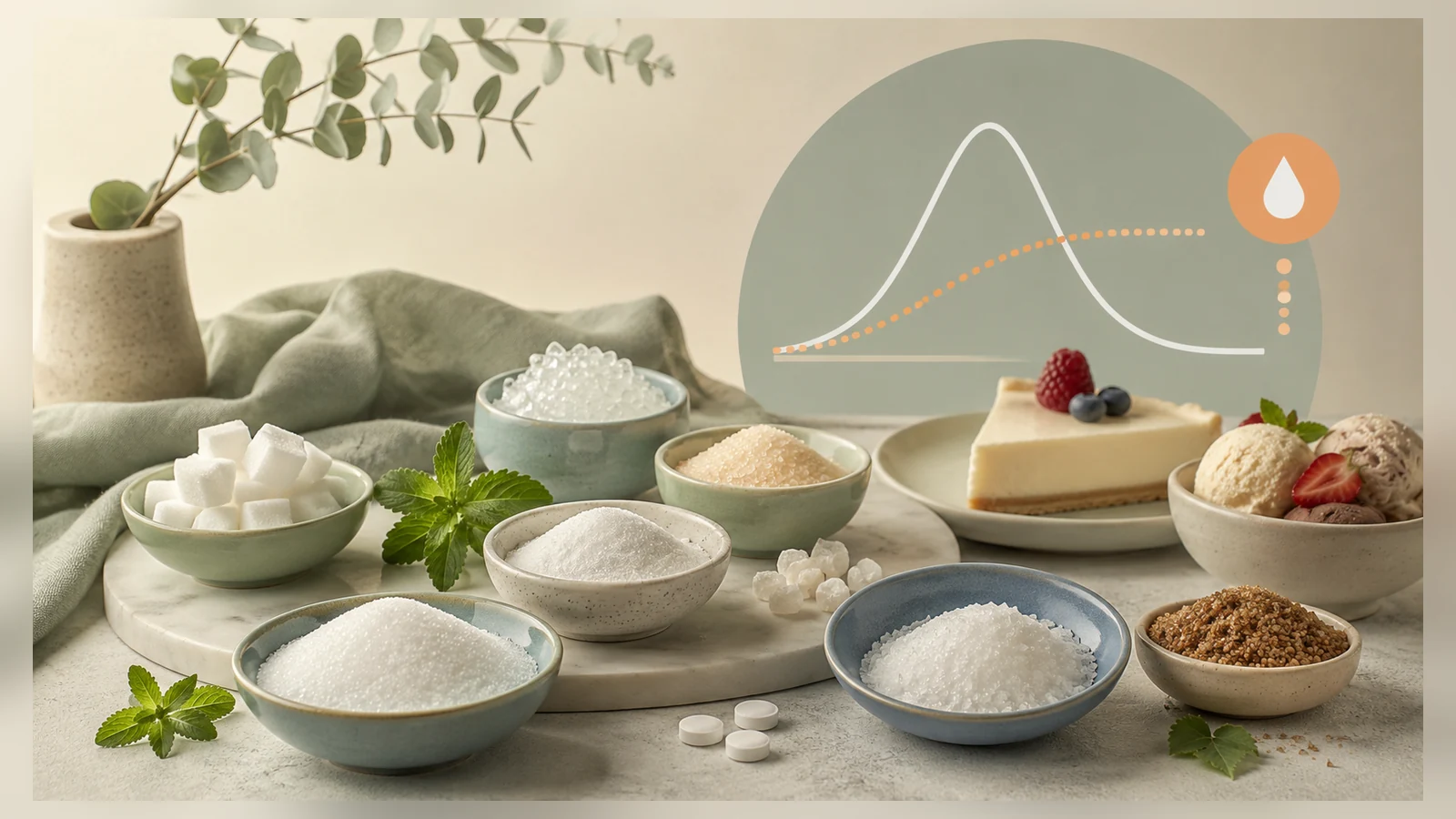
Sweeteners themselves provide no usable carbohydrates and generally don’t drive the acute blood-sugar curve directly upward: unlike sugar. But newer research adds two important points: first, the individual sweeteners differ markedly, and second, there can be indirect effects on glucose metabolism mediated by the gut flora, which are highly individual. Sweetener remains the better choice than sugar; it isn’t a free pass.
Not all sweeteners are the same
The most informative study on this is a randomised controlled trial of 120 healthy adults who had not previously consumed sweeteners (Suez and colleagues, published in Cell, 2022). For two weeks the participants each took one of four sweeteners in amounts below the acceptable daily intake. The result was nuanced: saccharin and sucralose measurably impaired glucose tolerance, whereas aspartame and stevia did not. All four, however, changed the composition of the gut microbiome.1
Particularly important: the response was strongly individual. The researchers distinguished “responders” and “non-responders”, some people reacted with worsened glucose tolerance, others not at all. In an elegant additional experiment they transferred the gut microbiome from study participants to germ-free mice, and the mice showed the same blood-sugar response as their human donors. That’s a strong indication that the gut flora is the mediator.1
The WHO guideline: not a tool for weight control
In 2023 the World Health Organization (WHO) published a guideline based on a systematic review. The core message: sweeteners should not be used as a means of long-term weight control or to lower the risk of non-communicable diseases (a so-called conditional recommendation).2 Observational studies even found associations between high sweetener consumption and an increased risk of type 2 diabetes and cardiovascular disease.2
Are sweeteners safe?
Yes: within the approved amounts. All sweeteners permitted in the EU undergo a safety assessment by the European Food Safety Authority (EFSA), which sets an acceptable daily intake (ADI) for each.3 For aspartame this value is 40 mg per kg of body weight, a 70 kg person would have to drink around 9–14 cans of a strongly aspartame-containing drink a day to reach it.3
In 2023 the International Agency for Research on Cancer (IARC) classified aspartame as “possibly carcinogenic” (group 2B). Important for context: this category describes the strength of the research, not the danger of a real amount. The responsible WHO/FAO committee (JECFA) confirmed the existing acceptable daily intake as safe the same year.3 For people with the rare metabolic disorder phenylketonuria, however, aspartame is unsuitable (labelling required).
What does this mean for everyday life?
- Sensible as a sugar replacement: replacing a lot of sugar (e.g. several sugar-sweetened drinks a day) with sweetener reduces calories and acute blood-sugar spikes. That’s the documented benefit.
- Not a free pass versus water: for lasting weight loss without the sugar comparison there’s no documented advantage. Water and unsweetened drinks remain first choice.
- The individual sweetener counts: aspartame and stevia fared better in the glucose study than saccharin and sucralose.
- Check individually: because of the microbiome-dependent response, with diabetes it’s worth looking at your own CGM.
- Long-term goal: to reduce the habituation to intense sweetness overall – regardless of the source.
Where the research is still open
To stay honest: much is not yet conclusively settled. The glucose study was short (two weeks) and carried out in healthy people – long-term consequences and the transfer to people with diabetes are still open. Combinations of several sweeteners, as found in many products, are also barely studied. And the data on individual substances differ greatly. Anyone promising absolute certainty here goes beyond the research.
Key takeaways
- Sweeteners generally don’t raise the acute blood-sugar curve directly – unlike sugar.
- Saccharin & sucralose worsened glucose tolerance in an RCT, aspartame & stevia did not (Suez, Cell 2022).
- The response is microbiome-dependent and individual (responders/non-responders).
- WHO 2023: not a tool for long-term weight control (conditional recommendation).
- What matters is the comparison: instead of sugar = benefit; instead of water = no documented benefit.
Article ID: SWF-W-028Please quote this ID for corrections or additions.
Sources
Sources as of: 21 Jul 2026.
- Suez et al. (Cell 2022): RCT, 120 adults; saccharin/sucralose impair glucose tolerance, aspartame/stevia not; microbiome mediation. cell.com (opens in a new window)
- WHO (2023): advises against non-sugar sweeteners for weight control; conditional recommendation. Guideline. who.int (opens in a new window)
- EFSA ADI values (e.g. aspartame 40 mg/kg); IARC 2B and JECFA confirmation; phenylketonuria. BfR FAQ. bfr.bund.de (opens in a new window)