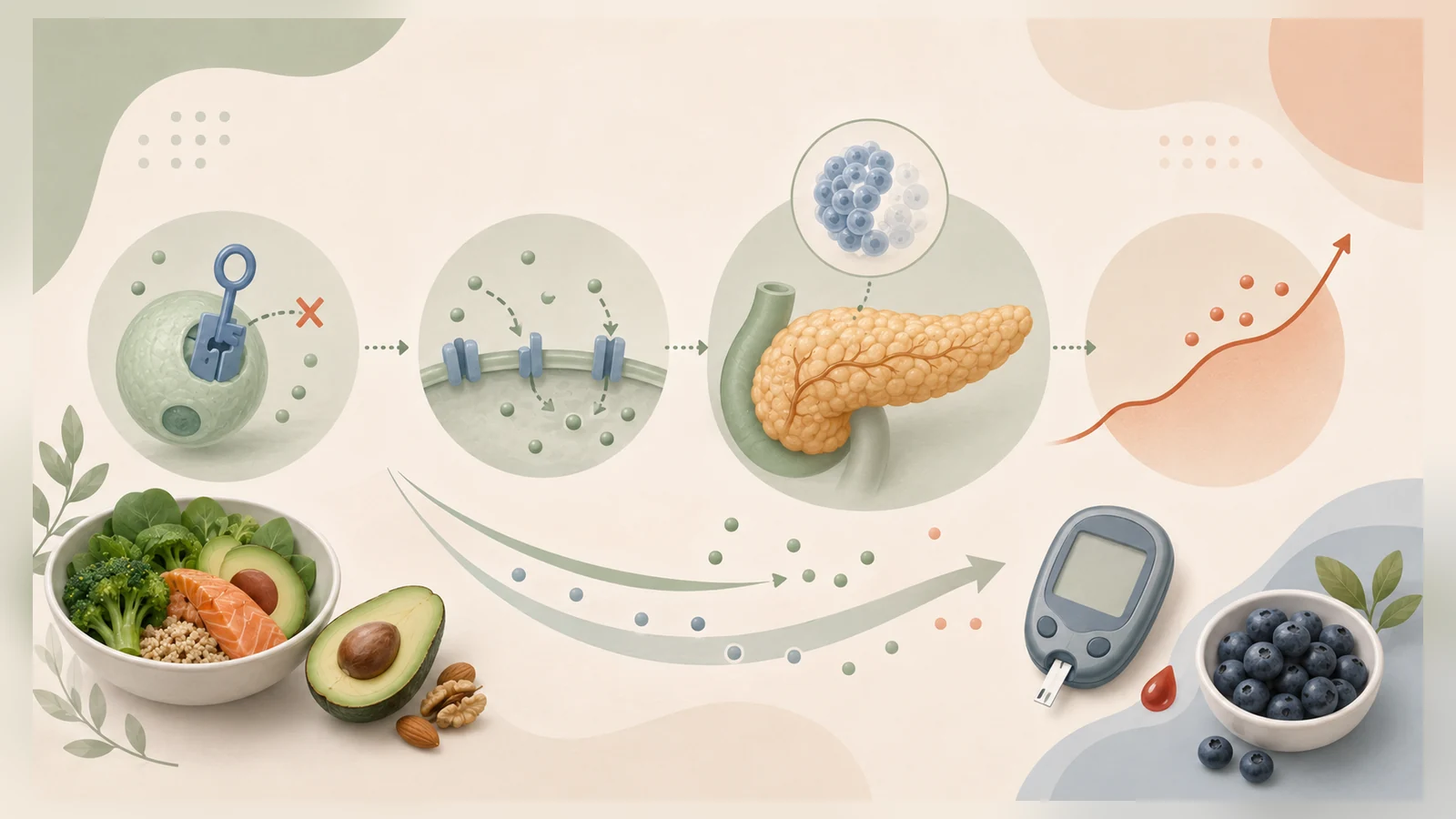
The term prediabetes describes a state in which blood sugar is above the normal range but hasn’t yet reached the diabetes threshold.1 Important: prediabetes isn’t a disease in its own right but a risk state, and a good moment to steer back.
The three routes to classification
There are three recognised measurements. Under the criteria of the American Diabetes Association (ADA), just one of them in the relevant range is enough:12
Why steering back pays off
Risk rises continuously with the value, and prediabetes isn’t a one-way street. Large prevention studies show that lifestyle measures can markedly delay or prevent progression to type 2 diabetes.1 The most effective levers are more movement, reducing belly fat and a fibre-rich diet.
What prediabetes actually is
Prediabetes isn’t a disease of its own but a precursor: blood sugar is already elevated but not yet in the diabetic range. Behind it is usually growing insulin resistance, cells respond less well to insulin, and the pancreas has to make more of it. The tricky part: prediabetes doesn’t hurt and usually causes no symptoms. It’s almost always found by chance in a blood test.
Who is particularly at risk
Risk rises above all with these factors:
- Abdominal overweight: fat in the belly especially drives insulin resistance.
- Family history: type 2 diabetes in parents or siblings.
- Lack of movement and a mostly sedentary day.
- Older age and a previous gestational diabetes.
Important: prediabetes is a warning sign, not a one-way street. In many people, blood sugar can be normalised again in this phase.
How to steer back, concretely
The most effective levers are well documented and practical:
- Movement: around 150 minutes per week of moderate activity: brisk walks count too.4
- Weight: even 5–7% less body weight markedly lowers risk.4
- Plate: more fibre and fewer fast carbs flatten the spikes.
- Walk after eating: 10–15 minutes noticeably dampen the rise.
Key takeaways
- Prediabetes = grey zone between normal and diabetes, a warning sign.
- Fasting glucose 100–125 mg/dl, OGTT-2h 140–199 mg/dl, HbA1c 5.7–6.4%.
- One value in the borderline range is enough to classify – but the tests don’t capture the same people.
- Lifestyle can markedly delay or prevent progression.
- Most effective levers: movement, less belly fat, fibre, post-meal walks.
Article ID: SWF-W-020Please quote this ID for corrections or additions.
Sources
Sources as of: 21 Jul 2026.
- Diagnostic criteria for prediabetes/diabetes (fasting, HbA1c, OGTT). American Diabetes Association. diabetes.org (opens in a new window)
- Prediabetes categories and overlap between tests (fasting, OGTT, HbA1c). Reference/guideline. ncbi.nlm.nih.gov (opens in a new window)
- WHO: intermediate hyperglycaemia / impaired fasting glucose thresholds. who.int (opens in a new window)
- ~150 min/week activity plus 5–7% weight loss delay/prevent type 2 diabetes (Diabetes Prevention Program). canr.msu.edu (opens in a new window)