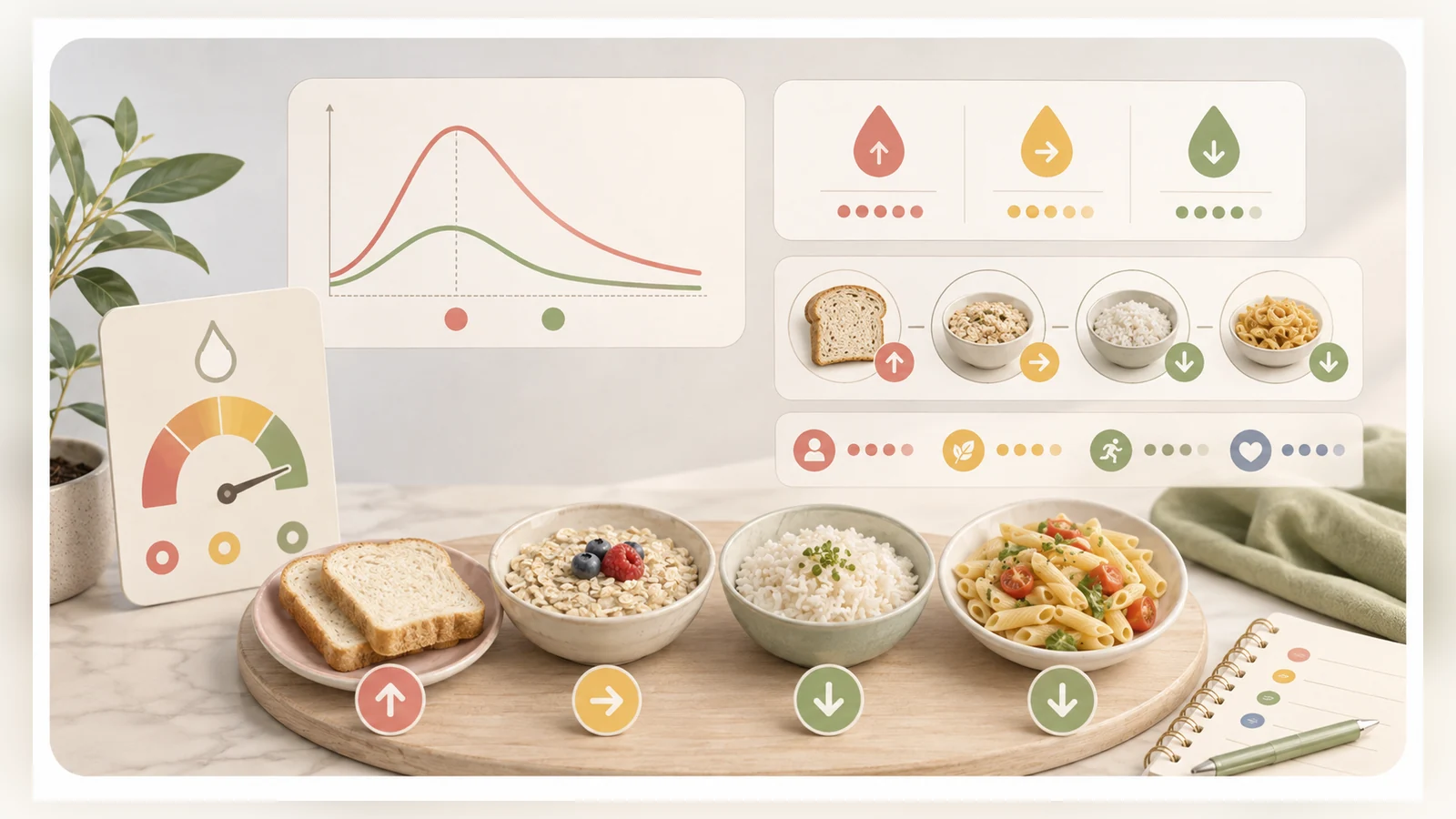
Of all nutrients, carbohydrates raise blood sugar the most, they’re broken down into glucose that passes into the blood. So it helps to understand which carbohydrates act how.
The three basic types
Traditionally we distinguish simple carbohydrates (sugars, e.g. in sweets, but also in fruit and milk), complex carbohydrates (starch, e.g. in grains, potatoes, legumes) and fibre.1 Simple sugars are usually absorbed quickly, starch more slowly, and fibre delivers barely any glucose to the blood.1
Glycaemic index and glycaemic load
The glycaemic index (GI) ranks foods by how fast they raise blood sugar. The glycaemic load (GL) is more meaningful because it also accounts for how many carbohydrates a normal portion contains.23
The classic example is watermelon: high GI but low GL, because a normal portion contains few carbohydrates.3 A low GL is 10 or below, medium 11–19, high from 20.
What counts in practice
The blood-sugar effect depends not only on the carbohydrate but on its companions: fibre, protein and fat slow absorption. A lower-carb or higher-fibre combination lowers the spike – shown in several intervention studies.4 In practice: more wholegrain, legumes, vegetables and fruit with skin; less refined sugar, white flour and white rice.2
Key takeaways
- Carbohydrates influence blood sugar the most.
- Three types: simple (sugar), complex (starch), fibre.
- “Complex = slow” is too simple – the actual effect varies.
- The glycaemic load is more meaningful than the index alone.
- Fibre, protein and fat dampen the spike.
Article ID: SWF-W-017Please quote this ID for corrections or additions.
Sources
Sources as of: 21 Jul 2026.
- Carbohydrate types and blood sugar; glycaemic index basics. City of Hope / overview. cityofhope.org (opens in a new window)
- Glycaemic index and glycaemic load explained. Oregon State University, Linus Pauling Institute. lpi.oregonstate.edu (opens in a new window)
- Carbohydrates and blood sugar; GL thresholds; watermelon example. Harvard Nutrition Source. nutritionsource.hsph.harvard.edu (opens in a new window)
- Fibre/protein/fat slow absorption and lower postprandial spikes. Review. ncbi.nlm.nih.gov (opens in a new window)