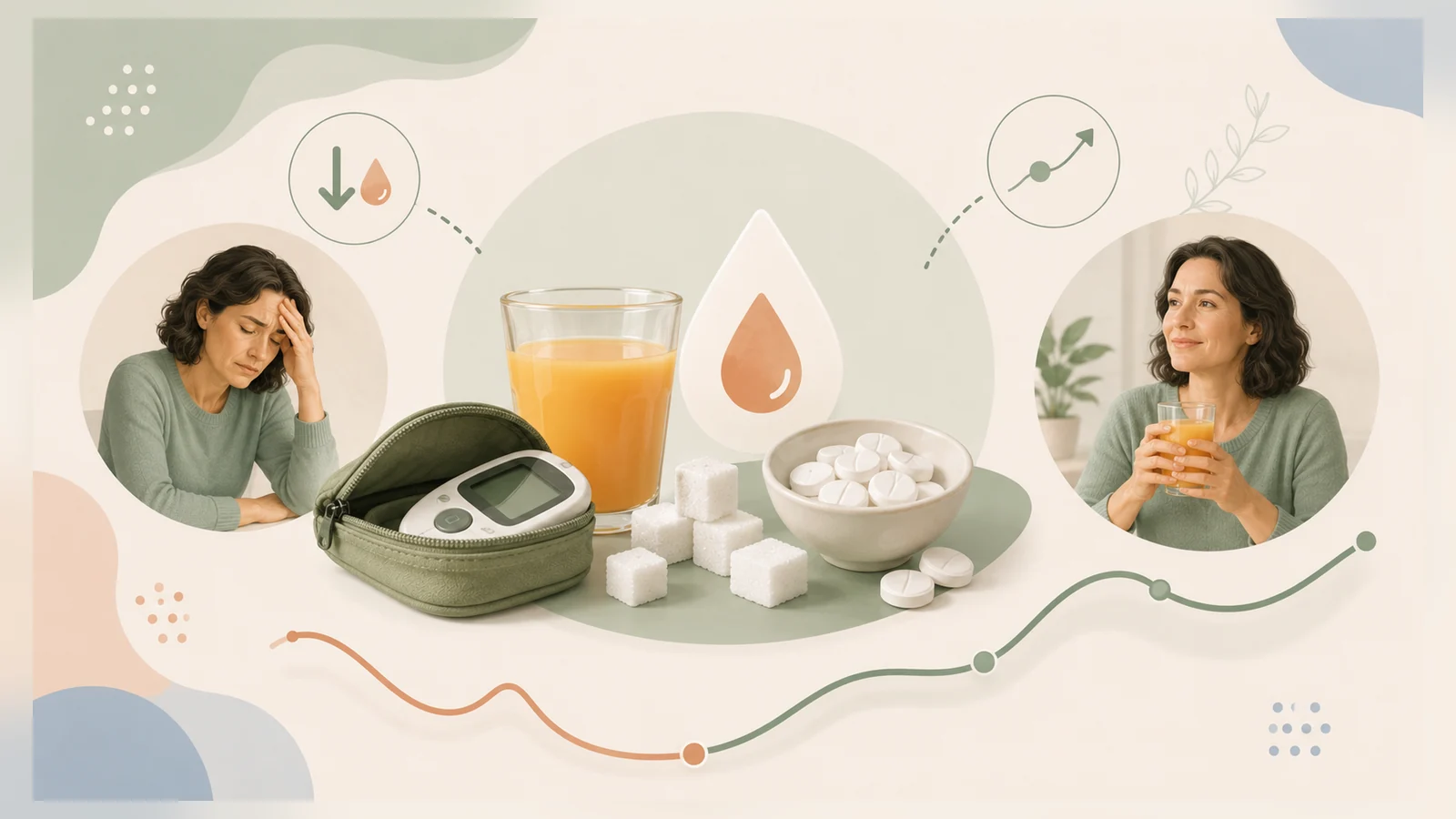
Hypoglycaemia (low blood sugar) in people on blood-sugar-lowering treatment usually means a blood sugar below 70 mg/dl (3.9 mmol/l). Values below about 55 mg/dl are considered marked (severe) and need special attention.
How to recognise it
The body first warns with typical alarm signs: trembling, sweating, palpitations, food cravings, paleness and restlessness. If sugar falls further, signs of a nutrient shortage in the brain follow: trouble concentrating, confusion, irritability, slurred speech and, in extreme cases, loss of consciousness. The signs vary between individuals: many people know “their” early warning signs.
What to do: the 15-15 rule
For a mild hypoglycaemia (you’re still awake and can swallow), a simple rule has proven useful:
So: take about 15 g of fast-acting carbohydrates (for example glucose tablets, juice or sugary lemonade), wait 15 minutes and then measure again. If the value is still too low, repeat the step. Chocolate or high-fat snacks are poorly suited, because the fat slows sugar uptake.
Why it happens, and impaired awareness
Hypoglycaemia almost exclusively affects people taking insulin or certain tablets (especially sulfonylureas). Triggers are often a skipped meal, unusually heavy exercise, too much medication or alcohol. Important: those who have frequent hypos may over time sense the early warning signs less well (hypoglycaemia unawareness), then more frequent measuring or a CGM and medical support are especially important.
If someone is unconscious or unable to swallow, give nothing by mouth and call emergency services (112) immediately. Glucagon should only be used by people who have been instructed in it.
Key takeaways
- Hypoglycaemia usually from < 70 mg/dl (on relevant treatment); < 55 mg/dl is severe.
- Early signs: trembling, sweating, palpitations; later confusion up to loss of consciousness.
- Mild hypo: the 15-15 rule – 15 g fast carbs, wait 15 min, measure again.
- Severe hypo is an emergency: call 112, give nothing by mouth, glucagon only after instruction.
- Most common cause: insulin/sulfonylureas; awareness can fade over time.
Article ID: SWF-W-015Please quote this ID for corrections or additions.
Sources
Sources as of: 21 Jul 2026.
- Hypoglycaemia: definition (<70/<54 mg/dl), signs, 15-15 rule, emergency and glucagon. ADA. diabetes.org (opens in a new window)
- Recognising and treating hypoglycaemia; impaired awareness. IQWiG / Gesundheitsinformation. gesundheitsinformation.de (opens in a new window)
- Causes and handling of hypoglycaemia; insulin/sulfonylureas. Diabinfo. diabinfo.de (opens in a new window)