
On 27 June 2026 the notes record two spaghetti ice creams, one small ice cream, a protein shake, 70 g of carbohydrate and a 30-minute Prodigy ride. The curve reflects the combined sequence; it cannot separate food from exercise.
The sequence
Only about 14 minutes separated the meal note and the start of the ride. The glucose reading had already moved from about 132 to 117 mg/dl. It then reached 110 mg/dl before rising to 165 mg/dl. This does not prove that the ride “failed”. It shows how food absorption and an early workout overlap.
What I take from it
Exercise is not a mathematical cancellation of carbohydrate. Gut absorption, muscle uptake, stress hormones and liver glucose output can occur at the same time. Future repeats need a documented portion, start time, starting value, ride duration and at least three hours of follow-up.
Limits
One day, no control condition, no standardised portion and the lag inherent in CGM: this is a personal case report, not advice.
Sources and methodological context
- American Diabetes Association, Standards of Care in Diabetes—2026: Physical activity and exercise
- Trefts et al., Exercise and the Regulation of Hepatic Metabolism
- Bergenstal et al., Glucose Management Indicator (GMI)
- Zaharieva et al., CGM lag during aerobic exercise
- Emhoff et al., Gluconeogenesis and hepatic glycogenolysis during exercise
The original measurement record remains unchanged. This section adds only method, sources, limitations and a reproducible follow-up plan.
The central question in this article
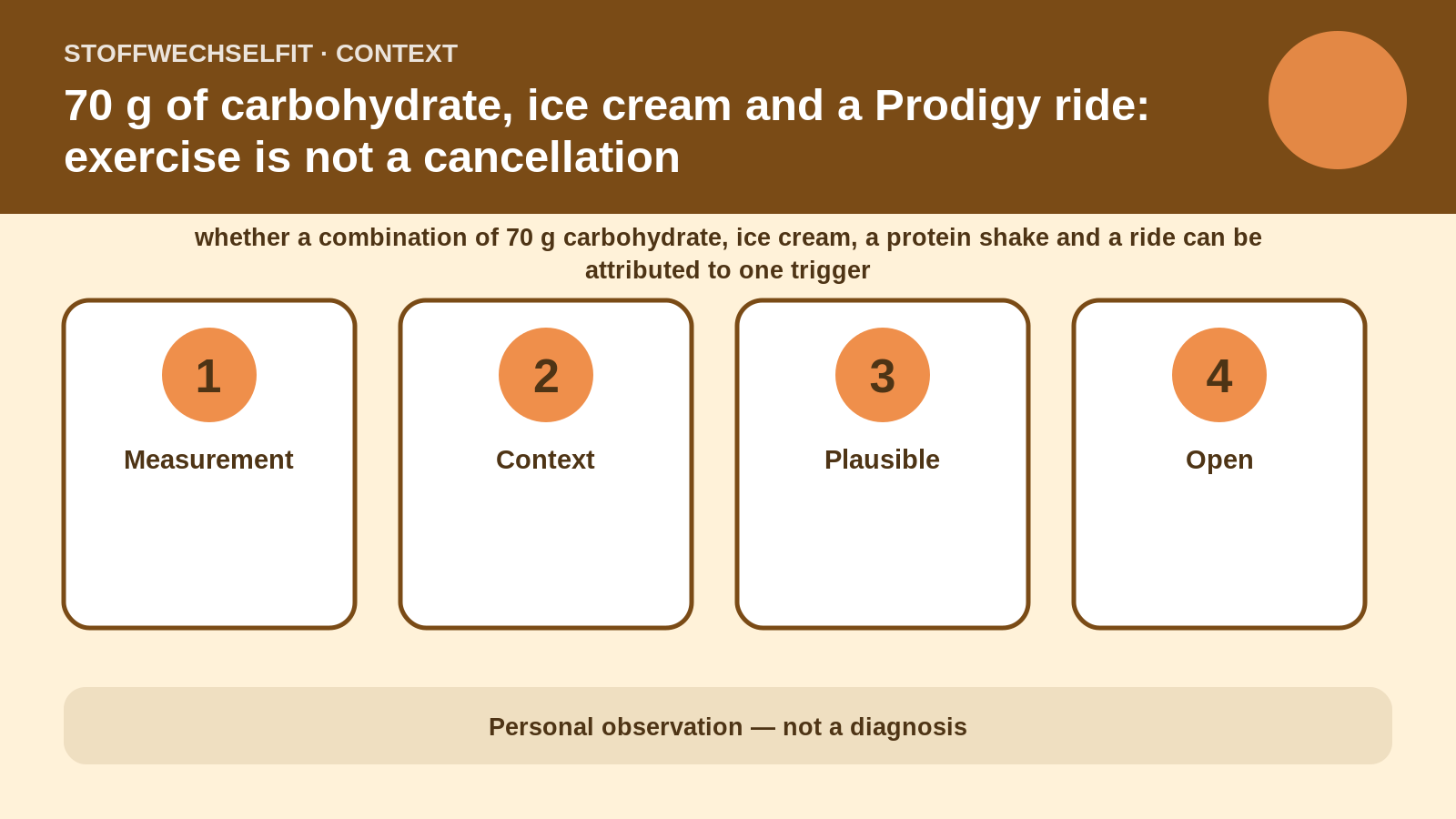
The article “70 g of carbohydrate, ice cream and a Prodigy ride: exercise is not a cancellation” examines whether a combination of 70 g carbohydrate, ice cream, a protein shake and a ride can be attributed to one trigger. The quality test is not whether one curve creates a compelling story. It is whether the timeline, data source, surrounding circumstances and alternative explanations are documented well enough for readers to separate observation from interpretation.
What the data show — and what they do not
A personal series can show timing and recurring patterns. It cannot by itself prove which physiological mechanism caused the pattern. Direct observation, plausible explanation and open question are therefore separated. Numbers remain linked to unit, time and data source, and missing details are not replaced with guesses.
Reading CGM correctly
Continuous glucose monitoring measures interstitial glucose. During rapid rises or falls, the display may follow blood glucose with a delay. Pressure on the sensor, a newly inserted sensor, hydration and short data gaps can add uncertainty. When a reading does not match symptoms or the situation, a confirmatory measurement may be appropriate depending on the clinical significance.
Technical context: Meals and food
Carbohydrate amount is a major driver of the post-meal response, but not the only one. Food structure, processing, protein, fat, fibre, eating speed and portion size influence both height and timing. Claims such as “sugar-free”, “high protein” or “low carb” describe only part of a product. The ingredient list, nutrition per portion and actual amount eaten need to be read together. Polyols and soluble fibres can differ substantially by substance and by person.
Article-specific interpretation
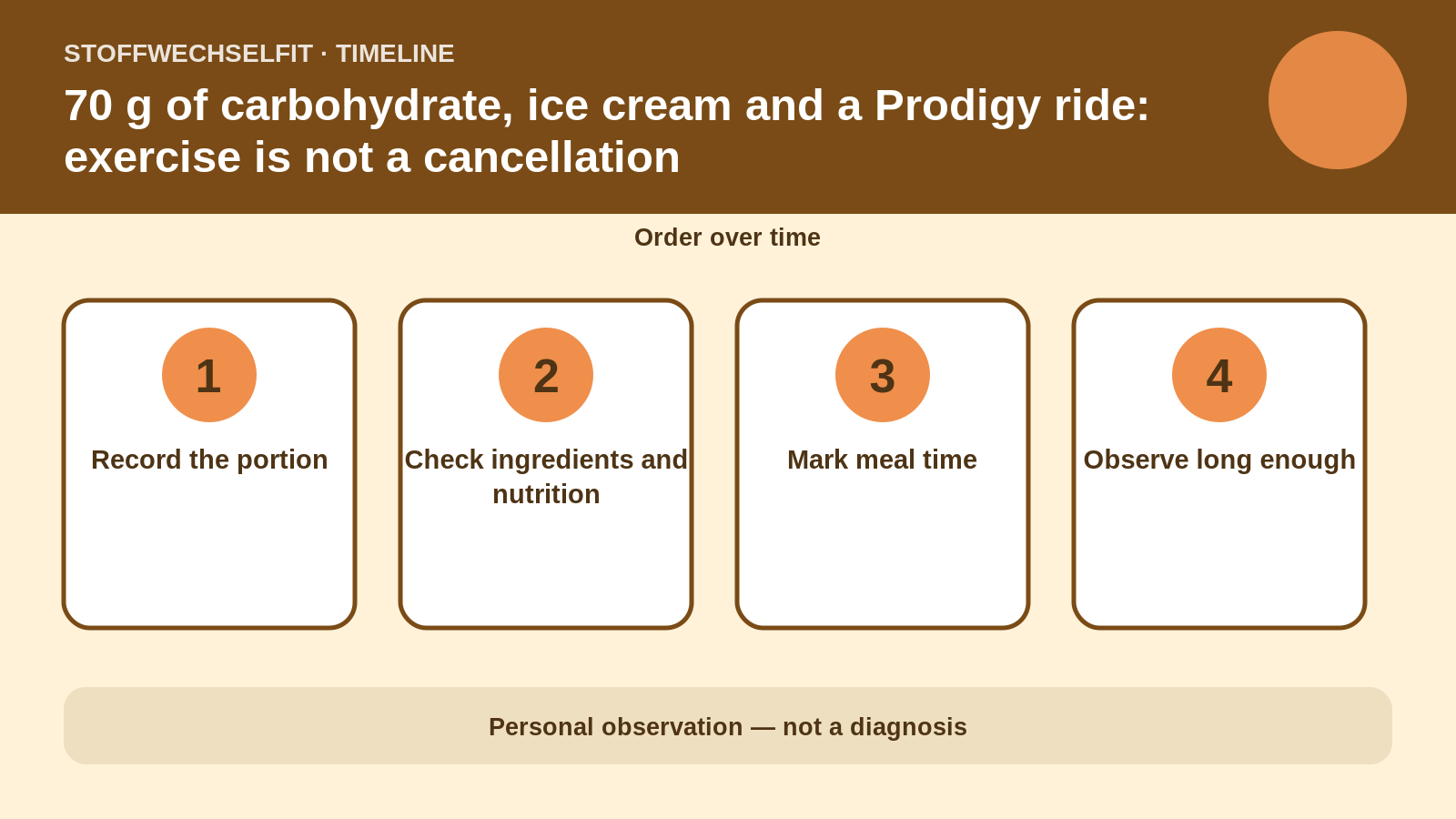
For “70 g of carbohydrate, ice cream and a Prodigy ride: exercise is not a cancellation”, this means first establishing which of the four phases — Record the portion, Check ingredients and nutrition, Mark meal time, Observe long enough — are actually documented. A missing phase is not guessed from the curve. This matters especially because whether a combination of 70 g carbohydrate, ice cream, a protein shake and a ride can be attributed to one trigger. More decimal places do not improve research; more complete context does.
Alternative explanations
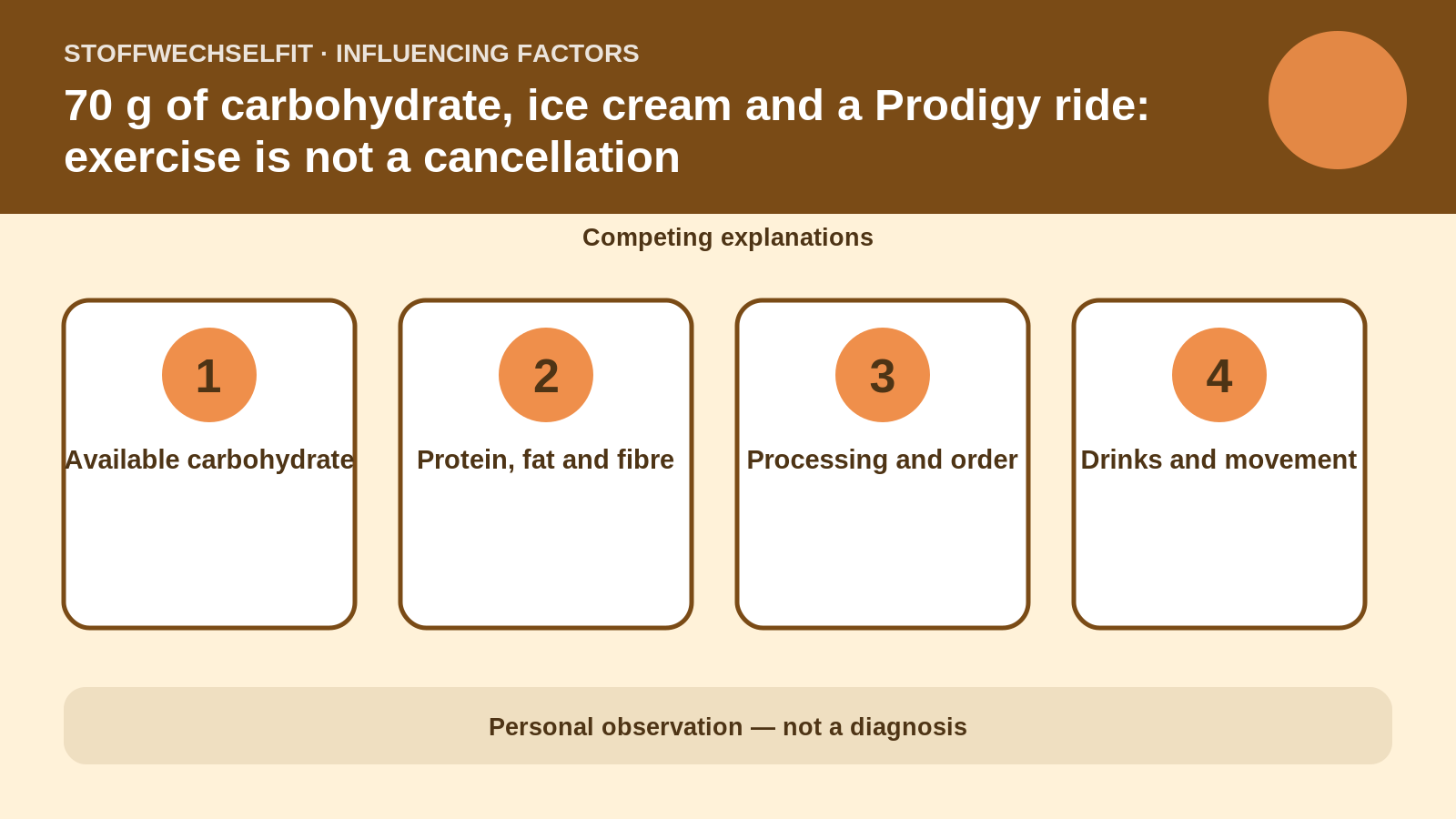
The competing influences considered are Available carbohydrate, Protein, fat and fibre, Processing and order, Drinks and movement. Several can act at once and partly mask one another. No factor is therefore declared causal merely because it occurred close in time. A plausible explanation remains labelled as plausible until a targeted comparison supports it.
Data sheet and provenance
The data sheet for “70 g of carbohydrate, ice cream and a Prodigy ride: exercise is not a cancellation” records more than the start and peak. It also covers Record the portion, Check ingredients and nutrition, Mark meal time and Observe long enough. Each section states whether a value was measured directly, read from a screenshot, calculated from raw data or reconstructed from memory. This keeps strong research separate from details that require later verification.
Typical failure modes
Common failure modes in this topic are incomplete portions, an incorrect time origin, events added retrospectively and observation ending too soon. For “70 g of carbohydrate, ice cream and a Prodigy ride: exercise is not a cancellation”, Available carbohydrate and Processing and order are particularly important competing explanations. A finding is therefore given more weight only when the same direction appears on several sufficiently similar days and counterexamples are documented as well.
Editorial decision
The editorial decision is to keep the personal experience visible without turning it into universal advice. Headline, hero image, alternative text, captions and conclusion must communicate the same uncertainty. When the article contains an open question, it ends with the next testable step — Weigh or estimate the amount — rather than a claim of effect.
Interpretation matrix
The interpretation matrix for “70 g of carbohydrate, ice cream and a Prodigy ride: exercise is not a cancellation” assigns every core statement to one of four classes: directly measured, calculated from several readings, physiologically plausible or still open. Direct measurement does not automatically establish causation. A calculated result requires a documented formula and time window. Plausible means consistent with physiology and timing but not isolated in the personal data. Open means that data, repetitions or comparison conditions are missing.
Publication review
Before publication, a final review asks whether the hero image matches the actual message of “70 g of carbohydrate, ice cream and a Prodigy ride: exercise is not a cancellation”, whether every number can be found in the text, whether units and timing are correct, and whether every image has alternative text and a caption. It also checks that Available carbohydrate or Protein, fat and fibre has not accidentally been turned into a proven cause. Only then is the article editorially complete.
Reproducible follow-up plan
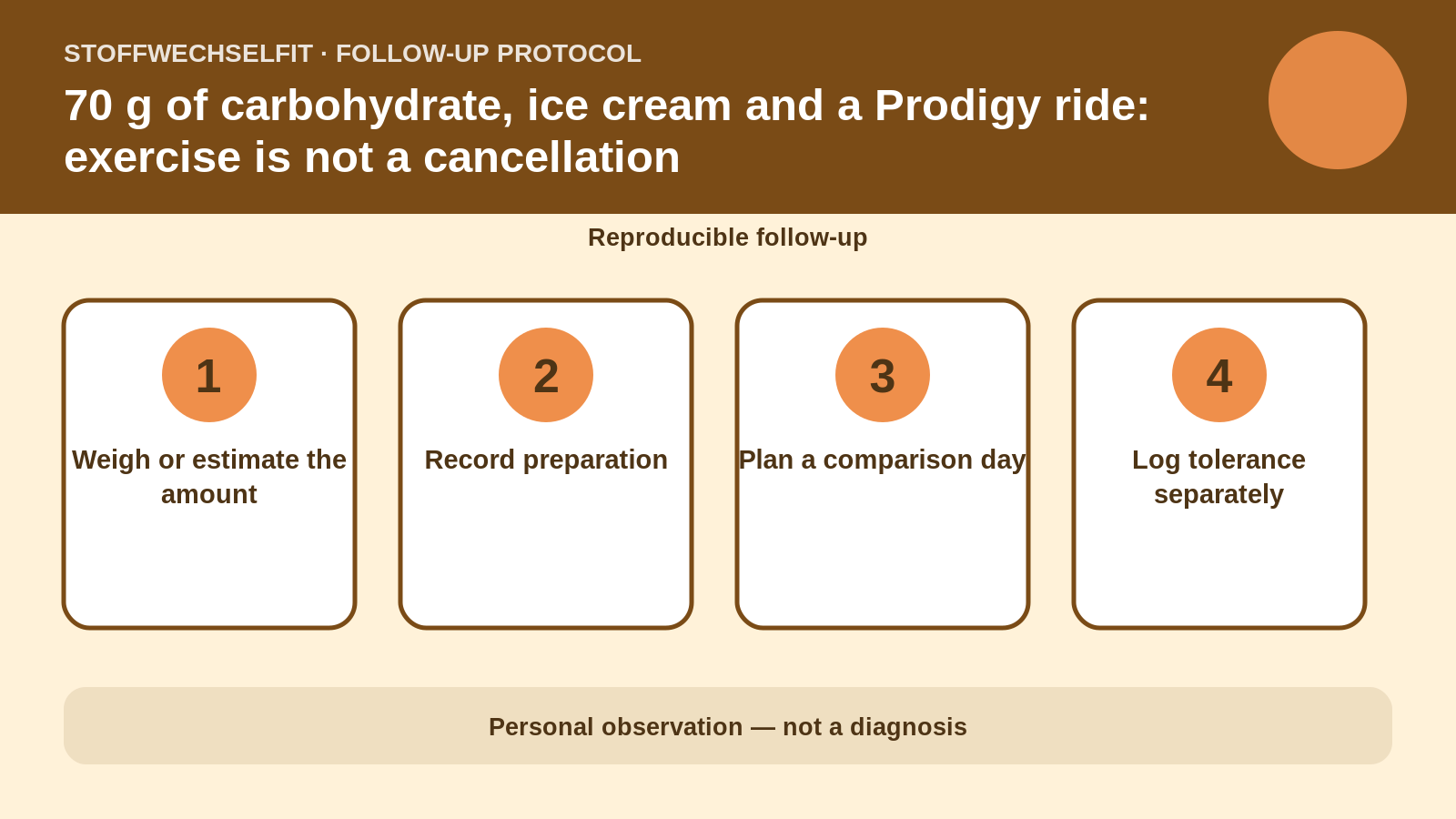
The next useful comparison follows four steps: Weigh or estimate the amount, Record preparation, Plan a comparison day, Log tolerance separately. This sequence turns a spontaneous observation into a protocol and reduces the risk of selecting only spectacular days while forgetting ordinary patterns.
What can be transferred
The transferable lesson from “70 g of carbohydrate, ice cream and a Prodigy ride: exercise is not a cancellation” is therefore not necessarily the exact number. What transfers are the question, the documented conditions and the handling of uncertainty. Other people may respond very differently because of treatment, fitness, insulin sensitivity, digestion or comorbidity.
Comparison rather than snapshot
A credible comparison starts with one clear question and conditions that are as similar as possible. Starting value, trend, time, portion, drinks, activity, sleep, stress and medication all belong in the record. Not every factor can be controlled; the important point is to show differences rather than explain them away afterwards.
State the observation window
Thirty minutes answers a different question from two, four or twelve hours. The article therefore states when observation begins and recognises that mixed meals, alcohol or intense activity can act later. A peak is not interpreted without the pattern before and after it.
Personal readings are not universal limits
Typical guideline targets can provide orientation but require individualisation. Age, comorbidities, pregnancy, medication, hypoglycaemia risk and personal treatment goals change the interpretation. The self-observations shown here do not replace diagnosis or treatment decisions.
Practical safety framework
Marked symptoms, recurrent hypoglycaemia, very high readings, ketones or a pattern that does not fit the situation require clinical assessment rather than another self-experiment. People using insulin or glucose-lowering medication must not derive dose changes or corrections from a blog post.
Further technical limitations
Mixed meals may produce a later or broader pattern. A short observation window can therefore miss a second wave. Drinks, side dishes, sauces and activity after the meal need to be included in comparisons. A personal curve is not a general verdict on a food. Tolerance, satiety and practicality are useful experiences, but they are reported separately from objective readings and from general nutrition guidance.
Questions before drawing a conclusion
- Is the starting value for “70 g of carbohydrate, ice cream and a Prodigy ride: exercise is not a cancellation” documented with trend and time?
- Are Available carbohydrate and Protein, fat and fibre described adequately?
- Did observation continue through “Observe long enough”?
- Is there a comparison day after “Weigh or estimate the amount”?
- Is each statement clearly labelled as personal, plausible or generally established?
Sources and context
- American Diabetes Association: Standards of Care in Diabetes—2026, health behaviours and exercise
- American Diabetes Association: Standards of Care in Diabetes—2026, glycaemic goals
- NIDDK: Healthy Living with Diabetes
- WHO: Healthy diet
- EFSA: Sweeteners – current re-evaluations and safety assessments
Medical notice: This article explains a personal observation and general context. It does not replace diagnosis, treatment adjustment or emergency care.
Editorial consistency
Additional quality rule for “70 g of carbohydrate, ice cream and a Prodigy ride: exercise is not a cancellation”: publication is released only when text, image, alternative text and caption tell the same story. The four visual documentation elements show Record the portion, Check ingredients and nutrition, Mark meal time, Observe long enough and Available carbohydrate, Protein, fat and fibre, Processing and order, Drinks and movement. They provide orientation and are not presented as diagnostic charts.
Data completeness
For “70 g of carbohydrate, ice cream and a Prodigy ride: exercise is not a cancellation”, the record also states what is missing. Unknown portions, uncertain times, undocumented drinks or an interrupted sensor trace remain visible as gaps. A gap is not replaced with an average or a physiologically possible story. That transparency is more valuable than an apparently seamless narrative.