Why walking of all things?
Hard training can backfire for me: if the effort is too intense, the body reads it as stress, and blood sugar then tends to rise again afterwards. Easy walking doesn’t have this drawback. It’s low-threshold, doable anywhere, family-friendly and needs no equipment. That’s exactly why it’s my default.
The test case: 205 mg/dl after the beer garden
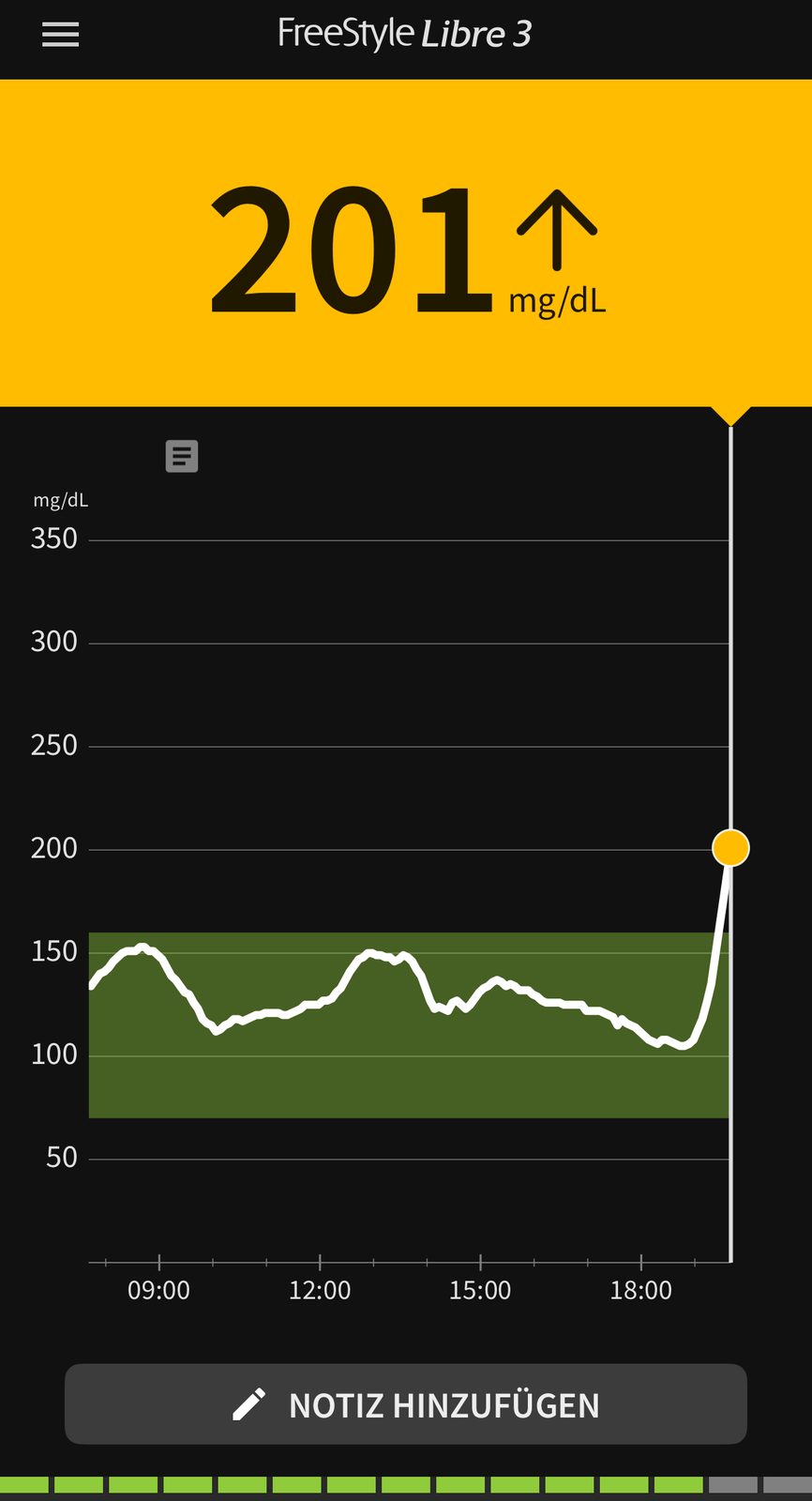
The most striking research was the evening of 16 July. After a lager, pepper steak and extra salad my value shot up to 205 mg/dl with a steeply rising arrow. Instead of waiting, I set off: about 3 km in 30–35 minutes. Afterwards the value normalised again. I’ve written up the whole detective work on that evening here.
The calm case: 96 mg/dl, just like that
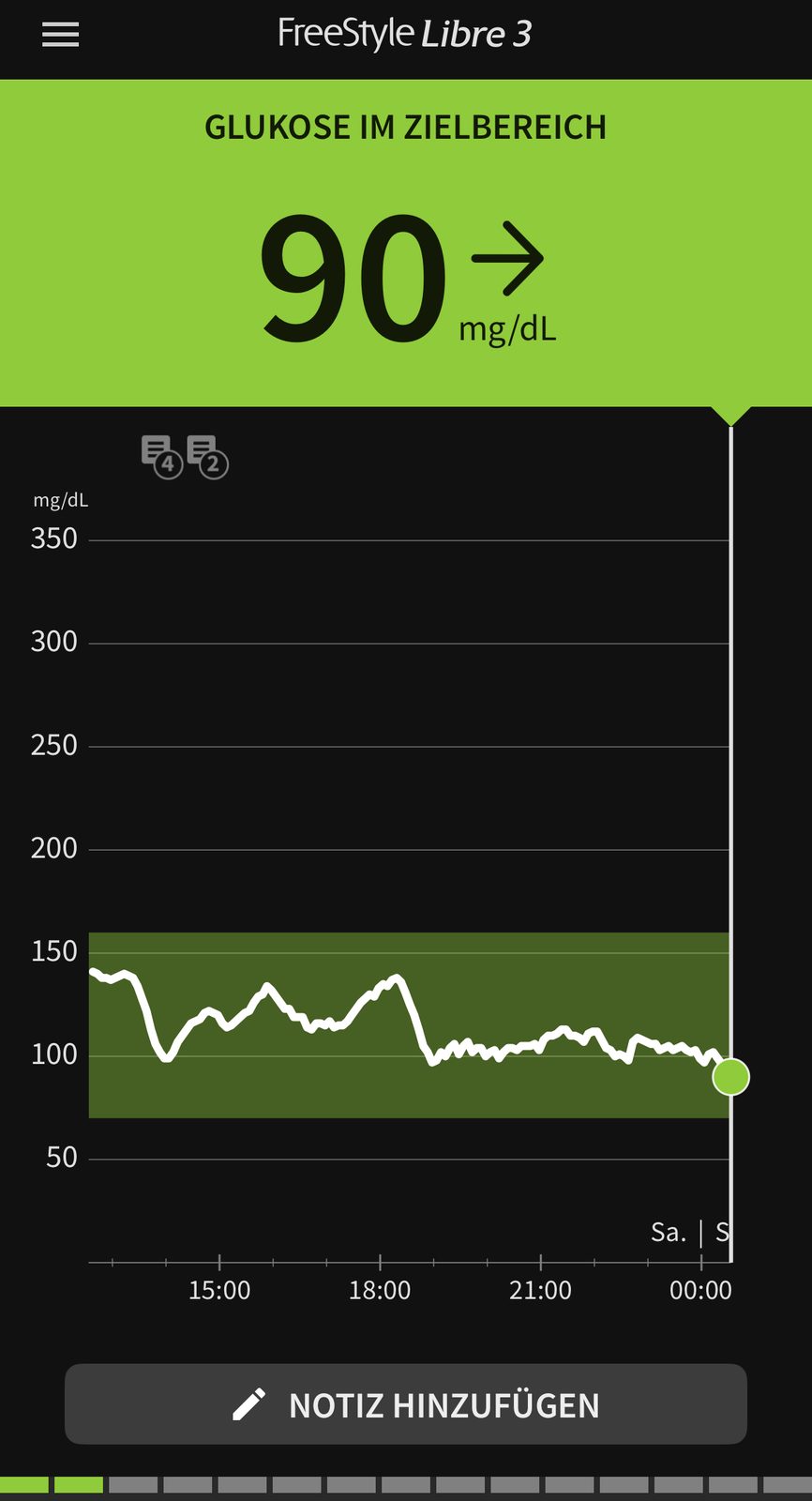
Another example from 12 July, 12:50: value at 96 mg/dl, slightly falling, no problem in sight. Note in the app: “walk 3 km”, 40 minutes. Not every walk is a rescue operation, most are simply routine that keeps the day stable.
The counter-example: movement isn’t just movement
What’s interesting is the contrast in my own data. On 12 July at 13:52 my notes say: “call-out h2.01 urgent door opening”, 13 minutes, at 138 mg/dl. That was physical activity, but under tension. For me that works differently from a calm walk: stress-intensive call-outs tend to drive the value up, easy walking down. That’s my pattern across many records, not a one-off, but also only mine.
What’s behind it
The mechanism is well documented: working muscles take up glucose, a partly insulin-independent pathway, running via the muscle contraction itself, plays a role. That’s why movement works even when insulin action is impaired. How strong the effect is varies individually: my numbers are no benchmark for others. More on this in the knowledge article Movement & blood sugar.
Key takeaways
- After larger meals: 20–30 minutes of easy walking, no rush.
- After an unexpected peak: set off right away, about 3 km / 30–35 minutes.
- After hard training: another 10–20 minutes of easy walking, if the training was stressful.
- Timing: after carb-rich meals I often wait ~20 minutes before starting.
- Easy walking (3 km / 30–40 min) is my most reliable tool after a peak.
- Movement isn’t just movement: activity under stress (e.g. a call-out) tends to raise my value.
- Muscle work promotes glucose uptake partly independent of insulin – so it works even with insulin resistance.
- On insulin/sulfonylureas: movement can cause hypoglycaemia – coordinate with your doctor.
The values in this article come from my own sensor (FreeStyle Libre 3) and are a single-case observation (n = 1) – they show a pattern in me, not a rule for you. Every statement is labelled as established, plausible or open, and proximity in time never counts as proof of a cause. How I handle time windows, sensor lag, influencing factors and approval is collected on one page. Read the methodology
Sources
This article is based on my own sensor readings. Where studies are mentioned, they are linked in the text. Interstitial glucose monitoring: FreeStyle Libre 3.