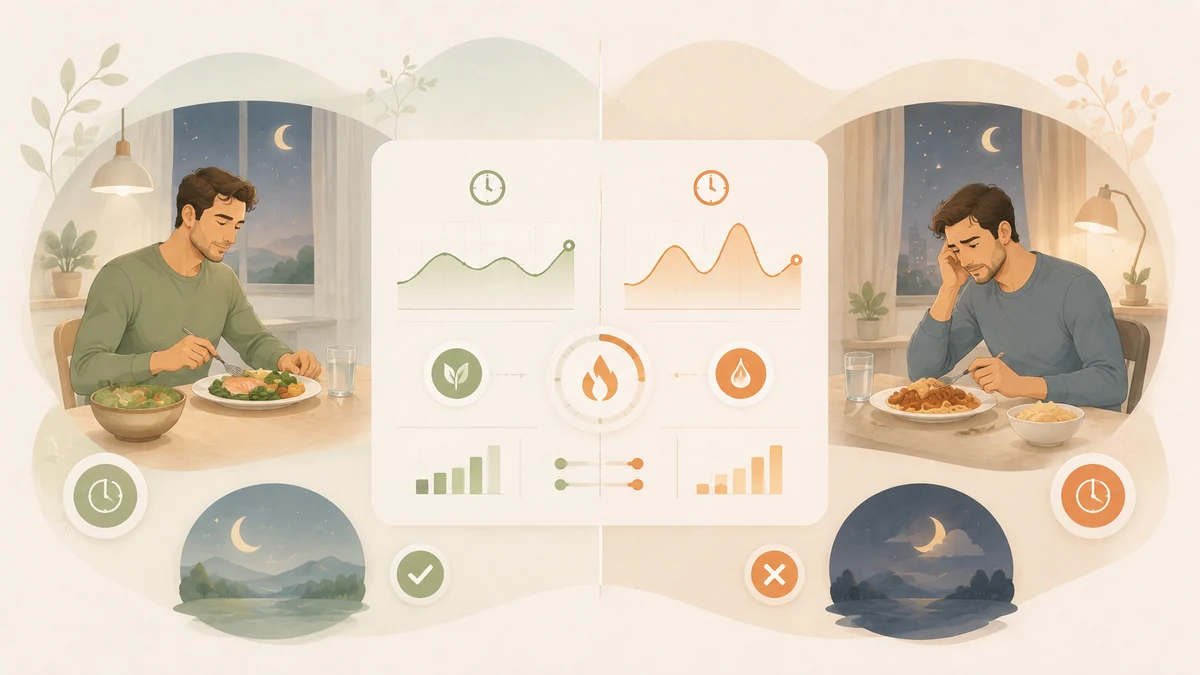
Same meal, two hours earlier. Two weeks of comparison — and a clearer difference than I expected.
What I did
In the first week I ate at around eight in the evening, in the second at around six. Same dishes, same portions. I looked at the readings between midnight and six in the morning.
What I saw
The overnight average was around 22 mg/dl lower in the week with the earlier meal. The morning value followed suit.
What might explain it
Insulin sensitivity varies over the day and is lower in the evening. Eating earlier also means the meal is digested before sleep. Both are plausible — which mattered more here, I cannot tell.
What I keep from it
Six in the evening does not always fit. When it does, I take it.
The stated magnitude is a personal observation from my sensor history. The complete reproducible raw-data record for the period, comparison days and evaluation is not yet available for this release. The number is therefore not treated as confirmed research, generally transferable or a recommendation.
A single observation with my own sensor. It shows what happened to me — not what applies generally. Sleep, stress and the previous day influence every reading.
Key points
- Dinner two hours earlier: overnight readings around 22 mg/dl lower.
- The morning value followed the same pattern.
- Lower evening insulin sensitivity is a plausible explanation.
- Two weeks, one person — an observation.
Single observation, not a study.
The values in this article come from my own sensor (FreeStyle Libre 3) and are a single-case observation (n = 1) – they show a pattern in me, not a rule for you. Every statement is labelled as established, plausible or open, and proximity in time never counts as proof of a cause. How I handle time windows, sensor lag, influencing factors and approval is collected on one page. Read the methodology
Sources
This entry is based on my own sensor readings. Where studies are mentioned, they are linked in the text. Continuous glucose monitoring: FreeStyle Libre 3.