1) What are the key questions before the trip?
Many problems can be avoided if you clarify a few things beforehand: ideally directly with the cruise line (e.g. TUI Mein Schiff or AIDA):
- Is there a nutrition/allergy consultation on board you can join?
- How is diabetes handled (e.g. labelling, advice, special requests)?
- Is there a ship’s doctor who can help in an emergency (e.g. with hypoglycaemia, giving glucose)?
- What options are there if you need to adjust food (e.g. no sugar / no flour / low carb)?
I haven’t taken part in such consultations so far, so this is mainly a pragmatic field report.
2) Drinks: the fastest lever for stable values
Non-alcoholic drinks. On Mein Schiff and AIDA you typically get: water (still/sparkling), Coke Zero / Light (depending on the system) and various teas (e.g. green tea).
Alcoholic drinks. Here what counts most is: carbs per 100 ml, and they add up.
- Beer: very variable by type. Example: Bitburger about 3.1 g carbs / 100 ml → 330 ml ≈ 8.25 g carbs. Example: Desperados about 5.5 g carbs / 100 ml → 330 ml ≈ 18.15 g carbs.
- Cuba Libre “Zero”: white rum + lime + Coke Zero → for me usually barely a rise.
- Moscow Mule: vodka + lime + ginger beer → ginger beer is often sugary, so check the carbs.
3) Postmix from the tap: “Did I really get Zero?”
On some ships, bar drinks often come from a dispenser: same tap, different button: cola, Coke Zero, water etc. That regularly made me wonder: was it really Zero?
My solution: a refractometer / sugar meter, of the kind used e.g. to measure sugar in grape must. It isn’t perfect, but it reliably shows the tendency: sweet or rather “Zero”. The trick of testing drinks with a classic blood glucose meter didn’t work for me, because the device expects blood. That may differ by manufacturer.
Practical rule: trust your senses. If it tastes different, it probably is. But a simple tendency check takes a lot of the stress out. On Mein Schiff I mainly had this issue at bars. In restaurants with self-service stations it’s easier, because you control the source yourself.
4) Food on board: orientation without perfect labelling
At buffet restaurants, dishes often aren’t labelled well enough to estimate carbs precisely. So a pragmatic approach helps:
- Sauces are often the “hidden” carb source (flour/thickening/sugar).
- Rule of thumb: the more “creamy” and thickened, the more likely extra carbs.
- I often chose meat/fish: ideally without sauce or with only a little.
That makes the decision easier and reduces “surprises”.
5) Breakfast: ideal for stabilising the day
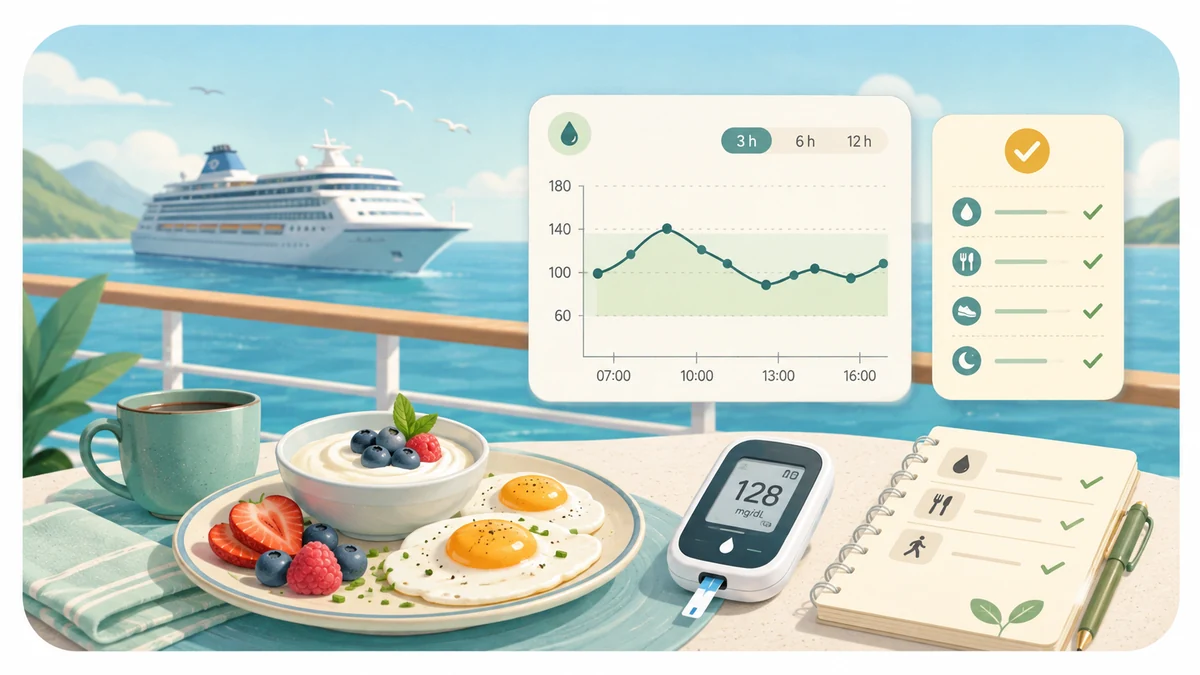
I found breakfast particularly strong on AIDA and Mein Schiff, because you can eat very blood-sugar-friendly there: omelette, scrambled eggs, fried egg, maybe sausages (blood-sugar-friendly, but not ideal daily for other health goals), with black coffee or green tea. A protein-rich breakfast helps me keep the morning more stable, especially when blood sugar tends to rise after getting up.
6) When I’ve “sinned”: compensating without drama
Honestly: eating “perfectly” all the time is no fun. Sometimes it’s mashed potato, pasta or an ice cream: that’s part of a holiday. What works well for me: movement to compensate (e.g. the gym on board).
7) The best standard measure: easy movement
Blood sugar “likes” light movement: 20–30 minutes of walking at a normal pace, ideally after larger meals, practical and family-friendly – often more lasting than “hard” training.
8) Blood sugar derailments: what concretely helps
When I notice my blood sugar tipping, these quick measures help me:
- Walking: 20–30 minutes at a brisker pace.
- Climbing stairs: up and down several times (the legs draw a lot of glucose).
- Squats: 20–30 repetitions (carefully, with clean form).
- Pilates: 20–30 minutes – doubly good for me: relaxation + training, without a strong feeling of stress.
- Ginger: A ginger shot sometimes lowers my value noticeably (I occasionally see ~20 mg/dl less). That is individual.
9) How do I notice a derailment – and when should I measure?
For me it is most helpful to measure 1 hour after eating. If everything is within range then (for me: roughly below 160 mg/dl), it usually doesn’t get “really bad” any more. I often read recommendations such as “measure 20–30 minutes after eating”. For me that is too early. In my case the main effect often only arrives after about 40 minutes. A measurement log over 1–2 weeks is a good way to find this out individually.
Typical signs for me: inner restlessness, with strong rises sweating and headaches. Then: no panic. Check whether movement is coming up anyway. If not: get briefly active (stairs, steps, a mini workout). That even works during appointments.
10) Mein Schiff 3: a quick impression
The cabins were strikingly clean and cleaned twice a day for us. The staff were friendly. A small tip often lifts the mood further. The entertainment seems modest at first but becomes much livelier: especially on sea days. Overall I found the atmosphere very pleasant.
11) Relaxation: underrated, but decisive
The most important point on a cruise for me is: lower the stress. On shore excursions you quickly stress yourself unnecessarily. You don’t have to be part of everything. Relaxation lowers the stress level and thus often the blood sugar too. Under stress I sometimes see +20 to +30 mg/dl, without food. That makes sense: the body provides energy (stress response). If you fight it internally, you amplify the effect. For me: less stress, more light movement, more rest – that often stabilises more than “perfect” food.
12) Training: helpful, but not as a stress trap
Training should be fun. You notice overexertion quickly. What impresses me every time: how fast blood sugar can fall during training. Example (for me): start at 115 mg/dl, after eating up to 160 mg/dl (rising), training (bike/running) → can quickly fall to ~70 mg/dl, then often settles back around 120–130 mg/dl.
The body has a “comfort level” it wants to return to. That also applies with higher fasting values. If I’m at 140–150 mg/dl fasting, I often end up back there after training. Reasons can be stress, infection, poor sleep, mental strain. Not every peak has a clean explanation. What matters is the long-term development and regular medical check-ups.
13) Shore days: a chance for stable values
Shore days are often ideal because you walk a lot. If I plan a long walking shore day, I sometimes eat a bit “more” beforehand, e.g. 2 rolls with cheese plus egg. Protein and fat slow the rise for me, and the movement burns off the rest. With guided tours involving a lot of bus travel it’s different: then I prefer a protein-rich, lower-carb breakfast, because on the bus you can barely counteract if you get symptoms.
Key takeaways
- Drinks are the fastest lever: water, Coke Zero, tea – avoid postmix and sweet cocktails.
- At the buffet, keep an eye on sauces; a protein-rich breakfast stabilises the day.
- Easy movement after eating often works more lastingly than hard training.
- Lower the stress: relaxation stabilises me more than “perfect” food.
- Measure one hour after eating – find your individual timing via a log.
The values in this article come from my own sensor (FreeStyle Libre 3) and are a single-case observation (n = 1) – they show a pattern in me, not a rule for you. Every statement is labelled as established, plausible or open, and proximity in time never counts as proof of a cause. How I handle time windows, sensor lag, influencing factors and approval is collected on one page. Read the methodology
Sources
This article is based on my own sensor readings. Where studies are mentioned, they are linked in the text. Interstitial glucose monitoring: FreeStyle Libre 3.