The appeal of repetition
It took me a long time to understand that boredom is a tool. Anyone trying something different every day collects experiences but no insights. Anyone doing exactly the same thing for a week suddenly sees things that previously drowned in the noise.
My mornings are now so uniform that they sound dull: get up, read the value, protein drink with 300 ml of unsweetened almond drink, then 45 easy minutes on the bike. That uniformity is no accident – it is the reason I noticed what this article is about at all.
Seven mornings, one pattern
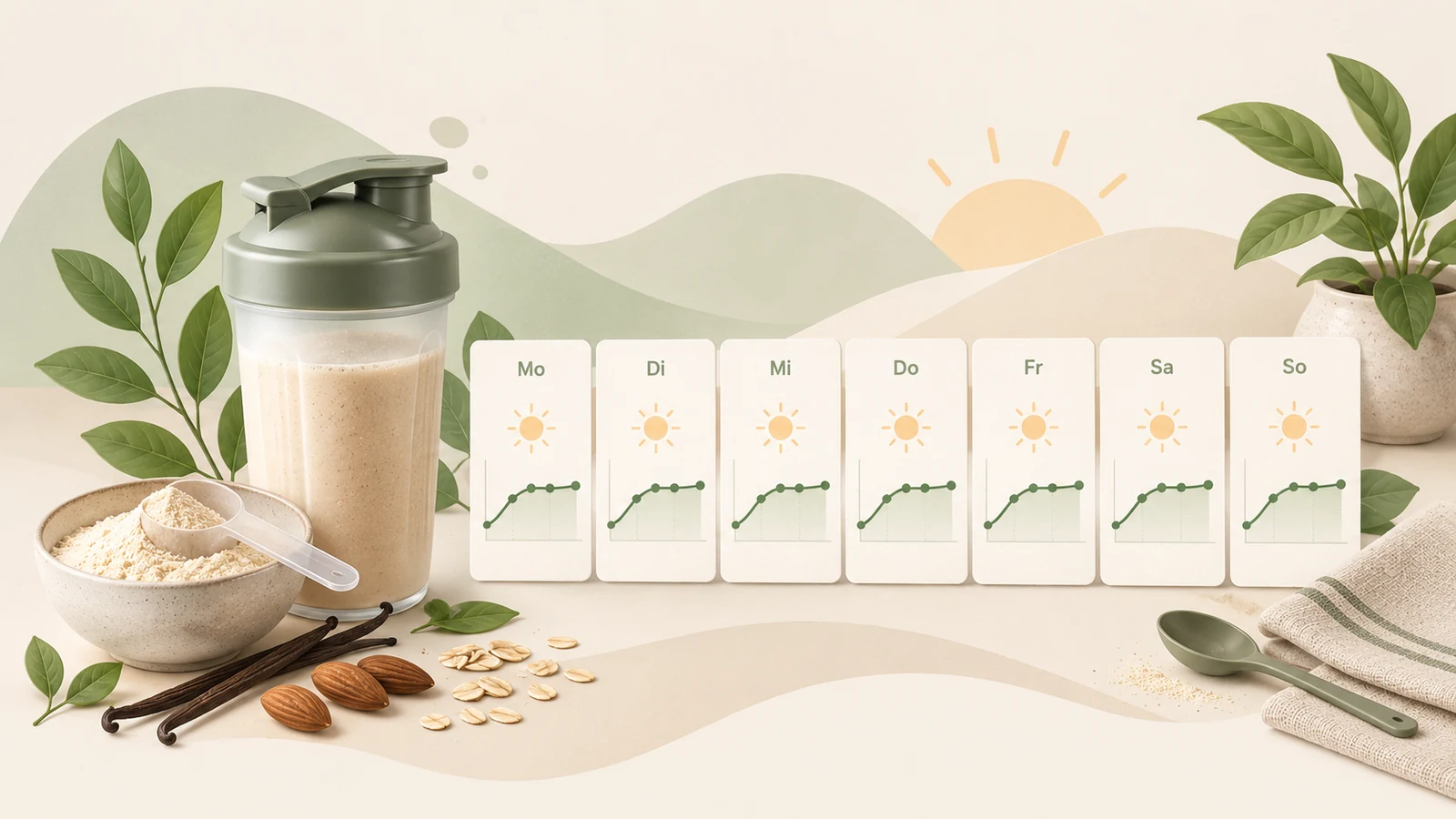
For a week the same flavour was in the glass. And every morning the sensor did the same thing: the value went up. Not dramatically, not alarmingly – but reliably. On the first day I put it down to a bad day. By the third I was curious. By the fifth it was clear there was a pattern.
The odd thing: nothing on the label explained it. A good four grams of carbohydrate per serving. That is about a fifth of a small bread roll. On paper it should barely register.
Not because I am especially attentive, but because everything else stayed the same. Had I also shifted my training time that week or skipped it once, I would never have spotted the pattern – I would have attributed the higher values to one of the changes and carried on.
Then came the switch
The next morning I took a different flavour. No plan behind it, no test design – the tub simply stood next to it and the other was empty. I measured out generously, considerably more than usual, because I had eaten little anyway.
And then something happened that I had not expected: the value barely rose. Despite almost double the amount. At first I thought I had misread it.
The moment where two paths open up
At this point there are two options, and I know both well. The first: you have the answer. Flavour A is bad, flavour B is good, you write that down and feel clever. That version is tempting because it is satisfying.
The second is less comfortable: you ask yourself what you actually measured. And if I am honest, I changed two things at once – the flavour and the amount. That makes the most interesting part of my observation simultaneously the most worthless. It could be the flavour. It could be the amount. It could be the previous evening.
For a while I preferred the first version. Not any more, and that has less to do with modesty than with experience: the quick explanations have turned out wrong too often in my case.
What might actually lie behind it
Afterwards I looked into what can distinguish two powders with similar numbers at all. It is more than I thought.
The protein itself, for instance. Whey is digested quickly and stimulates insulin release strongly – via certain amino acids and via gut hormones.2 Casein acts more slowly and flatter. Two flavours can be blended differently here without the nutrition table revealing it. And more insulin at the same sugar content usually means a flatter curve.
Or the form of the carbohydrates. Four grams as dissolved powder is not the same as four grams as a crunchy biscuit piece – the latter is usually starch from flour, and that becomes glucose quickly. The label shows the same number in both cases.
Or simply the fat. Fat brakes gastric emptying.3 A product with more fat can therefore produce a lower peak than a lighter one – which would explain why the larger portion produced the smaller spike. But only could explain.
The sentence that reassured me most
During the research I came across a study that helped me more than any product analysis. 800 people, a week of continuous monitoring, almost 47,000 meals recorded. The result: with identical standardised meals, blood sugar responses differed considerably between participants. For the same meal there were strong and weak responders.1
In plain terms: it is entirely normal for a product to act differently in me than in somebody else. If a flavour is praised in a review and still produces a spike in me, neither of us is wrong. We are simply two different people with two different digestive systems.
I used to ask myself what I was doing wrong when something did not work in me the way it should. I no longer ask that. It was the wrong question from the start.
That general dietary recommendations are pointless. They are average statements and useful as such – the fundamentals hold for almost everyone. What they cannot do is the fine tuning. That is exactly what a CGM is for, and exactly where personal observation starts to become worthwhile.
The thing about comparing
There is one point where I caught myself out, and it has nothing to do with measurements. As soon as I start comparing two products, I want one of them to win. That seems to be deeply built in.
With glucose curves, though, that is a poor way to think. A flavour that produces a spike in me is not thereby bad. It simply does not fit this one situation – fasted, in the morning, right before training. In the afternoon, after a meal, it might be entirely unremarkable. I have simply never tested it.
That is why this article contains no verdict on a product. Not out of deference to manufacturers, but because I could not support one. What I can describe is a situation: this powder, this morning, this sequence, this person.
What I learned about myself this week
Less about protein powder than about my own tendency to be finished too quickly. After two mornings I had an explanation, and it was plausible, and it would have sounded good. It just was not documented.
What I did instead: wrote down the design before the numbers exist. Three rounds per flavour, alternating, same amount, same time, same training. If a difference is still there afterwards, it is interesting. If not, it was the previous evening – and that too would be a finding.
This self-commitment is uncomfortable because it takes away the nice story. But it is the only way to end up with something that is more than a feeling.
Why I drink a shake in the morning at all
I get asked this fairly often, and the answer is less spectacular than many expect. It is not about building muscle and not about a particular dietary philosophy. It is about having a fixed point.
My blood sugar is raised in the morning anyway – the dawn phenomenon means the liver releases more glucose in the early hours. If I walk into that situation without any defined starting point, every morning turns out different. The shake is my anchor: same amount, same time, same liquid. Only that makes two days comparable.
The second reason is more practical. I ride for 45 minutes afterwards. Completely fasted, my value falls further – and the deeper it falls, the more forcefully it comes back. A shake with a good four grams of carbohydrate is not a meal, but apparently enough to make that fall gentler.
What the sensor changed
Before the CGM I had opinions about my metabolism. I knew what was good for me because I could feel it. Today I know I was wrong fairly often – not about the big things, but about almost all the small ones.
One example: I was convinced that a protein shake plays practically no role for blood sugar. Few carbohydrates, plenty of protein, done. That one flavour would produce a visible spike every morning across a whole week is something I would never have noticed without a sensor. I would have carried on believing the nutrition table.
For me that is the real value of all this measuring. Not the individual number, but the correction of assumptions you would otherwise carry around for years.
What I would tell others who want to try this
Above all one thing: do not start with the comparison, start with the routine. Anyone wanting to test two products against each other without a fixed sequence first is mostly measuring their own daily life. Only when the mornings resemble each other does it show when one steps out of line.
And then: one thing at a time. I know how tempting it is to change the flavour, the amount and the time all at once when you finally want an answer. That is exactly what I did, and it is why the end of this week holds not an answer but a better test design.
A word about the heat
In fairness I have to add something I only noticed while writing: during the week in question it was over thirty degrees outside and twenty-seven in the bedroom. Dehydration raises blood sugar, and in heat more frequent testing is expressly advised.4
So it is quite possible that part of what I attributed to the flavour was simply the weather. That does not make the observation worthless – but it makes it an observation rather than a finding. Which is precisely why the test now comes properly, with alternating rounds, so that such effects distribute across both sides.
How I handle it
I keep drinking both flavours. One in the morning before the bike, the other rather on days when I do not ride straight afterwards. That is not science but a working hypothesis that has served me – until the measurement series says otherwise.
And I have stopped drawing conclusions from individual mornings. A value is a value. Only the pattern across a week is information. That is the real lesson from this week, and it has only marginally to do with protein powder.
The essentials at a glance
- A week on the same flavour under matching conditions: the same spike every morning.
- After switching to a different flavour the curve was flatter – despite almost double the amount.
- Methodologically weak: I changed flavour and amount at once, so no cause can be attributed.
- Possible explanations: the whey-to-casein ratio, the carbohydrate form (dissolved versus biscuit piece), fat content as a brake.
- In a study of 800 people, participants responded very differently to identical meals – so other people’s product reviews transfer only to a limited extent.
- The heatwave above 30 degrees is a real confounder that I initially overlooked.
- Consequence: fix the design beforehand, three rounds per flavour, alternating, same amount.
Sources
Sources as of: 26 Jul 2026.
- Zeevi D. et al.: Personalized Nutrition by Prediction of Glycemic Responses. Cell 163(5):1079-1094 (2015). 800 participants, 46,898 meals: the response to identical standardised meals differed considerably between people. cell.com (opens in a new window)
- Salehi A. et al.: The insulinogenic effect of whey protein is partially mediated by a direct effect of amino acids and GIP on β-cells. Nutr Metab 9:48 (2012). Whey raises insulin, amino acids, GIP and GLP-1. ncbi.nlm.nih.gov/PMC3471010 (opens in a new window)
- Review of the insulinotropic effects of whey protein: the effect is multifactorial, with delayed gastric emptying also contributing. Ann Nutr Metab 69(1):56 (2016). karger.com (opens in a new window)
- Diabetes UK / Diabetes.co.uk: heat and diabetes – dehydration can raise blood sugar; more frequent testing is advised at high temperatures. diabetes.co.uk (opens in a new window)