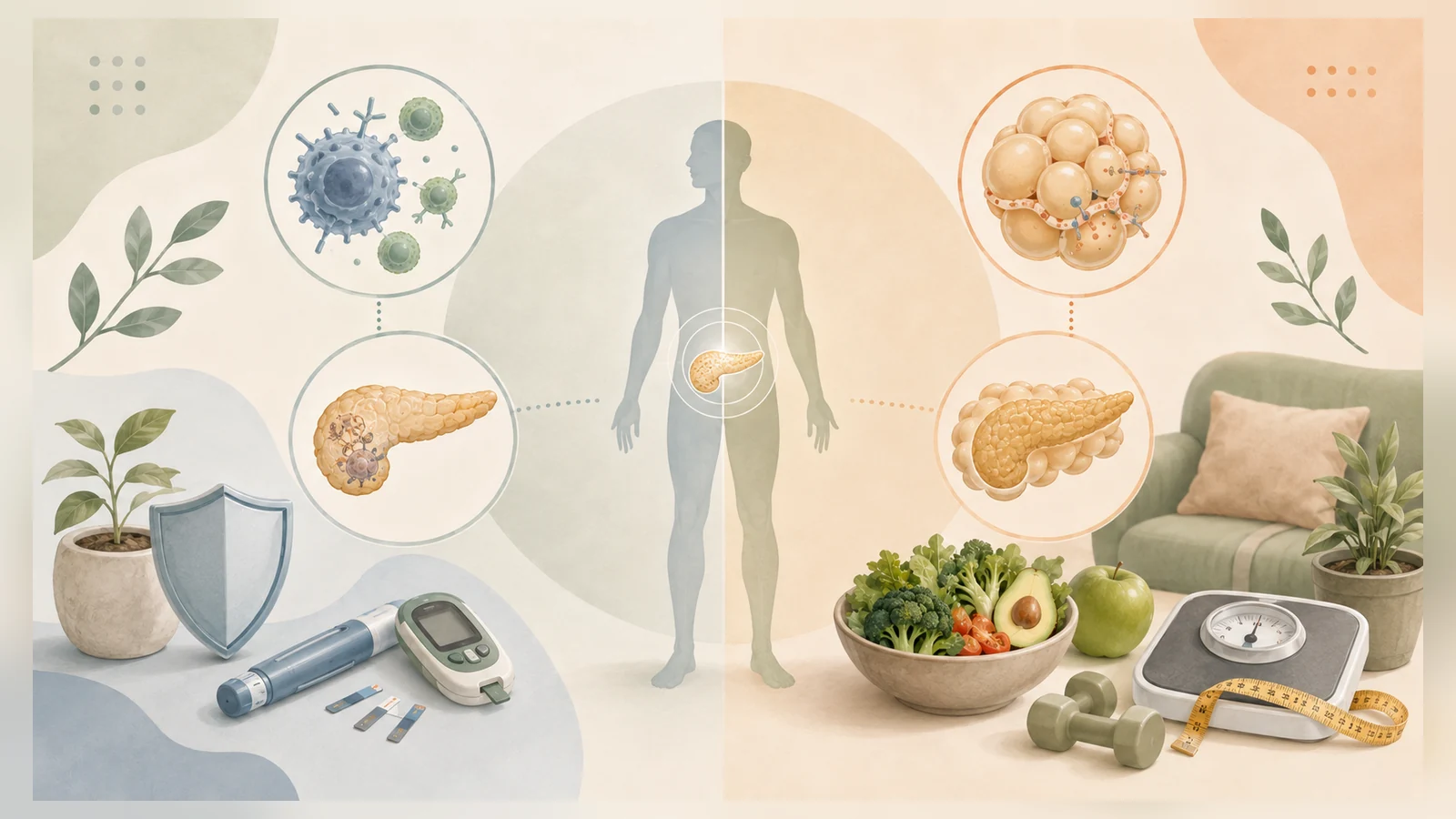
The common denominator is blood sugar that’s too high. But the paths there are fundamentally different: in type 1 insulin is almost entirely missing; in type 2 there’s enough, it just works poorly. That’s exactly what explains the different treatment.
Type 1: the immune system attacks insulin production
Type 1 diabetes is an autoimmune disease: the body’s own defences destroy the insulin-producing beta cells in the pancreas. The result is an absolute insulin deficiency: the body can barely produce its own insulin. Type 1 makes up about 5–10% of all diabetes cases, often begins in childhood or young adulthood, and usually appears fairly acutely with clear symptoms such as strong thirst, frequent urination and weight loss. Because there’s barely any insulin of one’s own, lifelong insulin therapy is necessary from the start.
Type 2: insulin works less well
In type 2 diabetes there’s initially enough insulin, but the cells respond to it less and less (insulin resistance). The pancreas compensates with extra work for a while, until it eventually can’t keep up (relative insulin deficiency). At about 90–95%, type 2 is by far the most common form, mostly affects adults and develops gradually over years: often without symptoms. It’s treated first through lifestyle (nutrition, movement) and, if needed, medications; sometimes insulin becomes necessary later.
Why the distinction matters
The right classification determines treatment: type 1 always needs insulin, here it would be dangerous to rely on lifestyle alone. In type 2, by contrast, a lot can often be moved through nutrition, movement and weight, sometimes up to remission. The diagnosis is always made by medical professionals, using blood sugar, HbA1c, antibodies and C-peptide, among others.
Key takeaways
- Type 1: autoimmune, absolute insulin deficiency, ~5–10%, often young, acute, always insulin.
- Type 2: insulin resistance + relative deficiency, ~90–95%, mostly adults, gradual.
- Intermediate forms like LADA and MODY exist; C-peptide and antibodies help distinguish them.
- Treatment depends on the type – the diagnosis is always made by a doctor.
Article ID: SWF-W-029Please quote this ID for corrections or additions.
Sources
Sources as of: 21 Jul 2026.
- Type 1 vs. type 2: causes, frequency, onset and treatment. Diabinfo (German Diabetes Information Portal). diabinfo.de (opens in a new window)
- Type 1 diabetes: autoimmune destruction of beta cells, insulin therapy. IQWiG / Gesundheitsinformation. gesundheitsinformation.de (opens in a new window)
- Classification and diagnosis (antibodies, C-peptide, HbA1c); LADA/MODY. ADA Standards of Care. diabetesjournals.org (opens in a new window)