Unlike HbA1c or the fasting value, the OGTT is a “challenge test”: it deliberately challenges glucose metabolism and thus shows how well regulation works.
How the test works
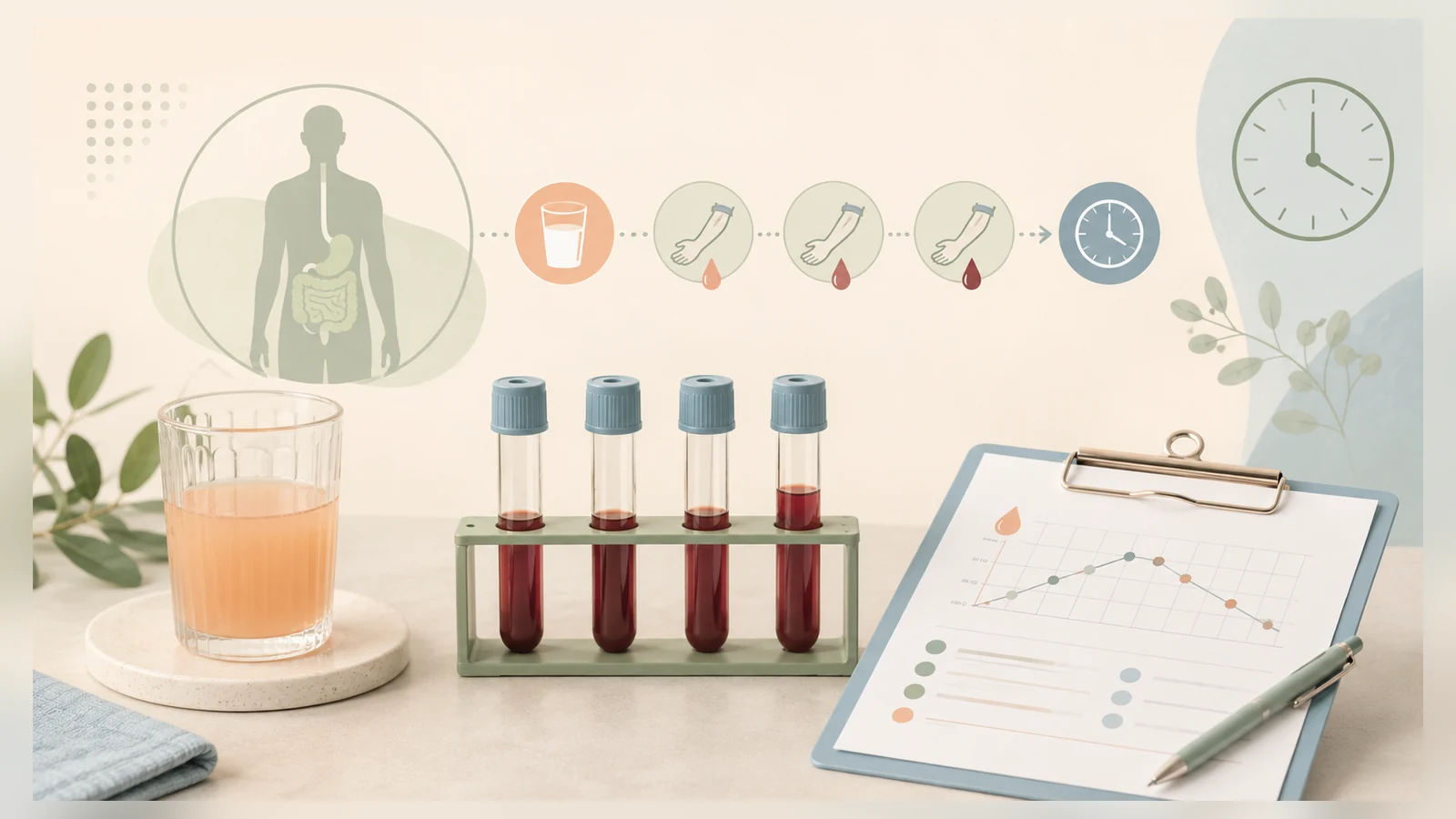
You arrive fasting (after about 8–12 hours without food). First the fasting value is measured. Then you drink a defined glucose solution, the standard is 75 g of glucose in about 200–250 ml of water. After two hours, blood is drawn again.1 Comparing the values shows how the body handles the sugar.
How the values are graded
What matters most is the 2-hour value. Under WHO criteria: below 140 mg/dl is normal, 140–199 mg/dl is impaired glucose tolerance (prediabetes), and from 200 mg/dl the diabetes range.1 The fasting value is also assessed (from 126 mg/dl suspicious for diabetes).1
The OGTT in pregnancy
The test plays a special role in gestational diabetes. Here a 75-g OGTT is typically performed between weeks 24 and 28 of pregnancy, with its own, stricter thresholds.2 Important: HbA1c is not suitable for diagnosing gestational diabetes: there is no way around the OGTT here.24
When and why the test is done
The oral glucose tolerance test is used when the fasting value or HbA1c is inconclusive or a closer look is needed. It uncovers disturbances in sugar processing earlier than the fasting value alone, because it shows how the body actually copes with a defined amount of sugar. In pregnancy it is the standard for screening for gestational diabetes.
How to prepare
For a meaningful result, a few rules apply: eat normally in the days before (don’t deliberately go low-carb), arrive fasting on test day (at least 8 hours), and during the waiting time sit calmly, don’t smoke and don’t exert yourself: all of that would skew the values.
Limits of the test
The OGTT is a snapshot and varies from day to day more than HbA1c. A single borderline value is therefore not a verdict but a reason to look more closely. Abnormal results always belong in medical hands and, if needed, confirmation.
Key takeaways
- The OGTT uses 75 g of glucose to test how well the body processes sugar.
- Procedure: measure fasting, drink glucose solution, measure again after 2 hours.
- 2-hour value: <140 normal, 140–199 prediabetes, from 200 mg/dl diabetes.
- Considered the gold standard: uncovers more than HbA1c or fasting alone.
- Indispensable in pregnancy; HbA1c isn’t suitable for that diagnosis.
Article ID: SWF-W-019Please quote this ID for corrections or additions.
Sources
Sources as of: 21 Jul 2026.
- OGTT procedure and WHO grading of the 2-hour value; fasting threshold. Reference. ncbi.nlm.nih.gov (opens in a new window)
- 75-g OGTT in pregnancy (weeks 24–28), stricter thresholds; HbA1c unsuitable. Guideline. fogsi.org (opens in a new window)
- OGTT indications, preparation and limitations. Reference. emedicine.medscape.com (opens in a new window)
- Gestational diabetes: 75 g OGTT at weeks 24–28, IADPSG criteria; HbA1c unsuitable; factors influencing the result. myadlm.org / Medscape. emedicine.medscape.com (opens in a new window)