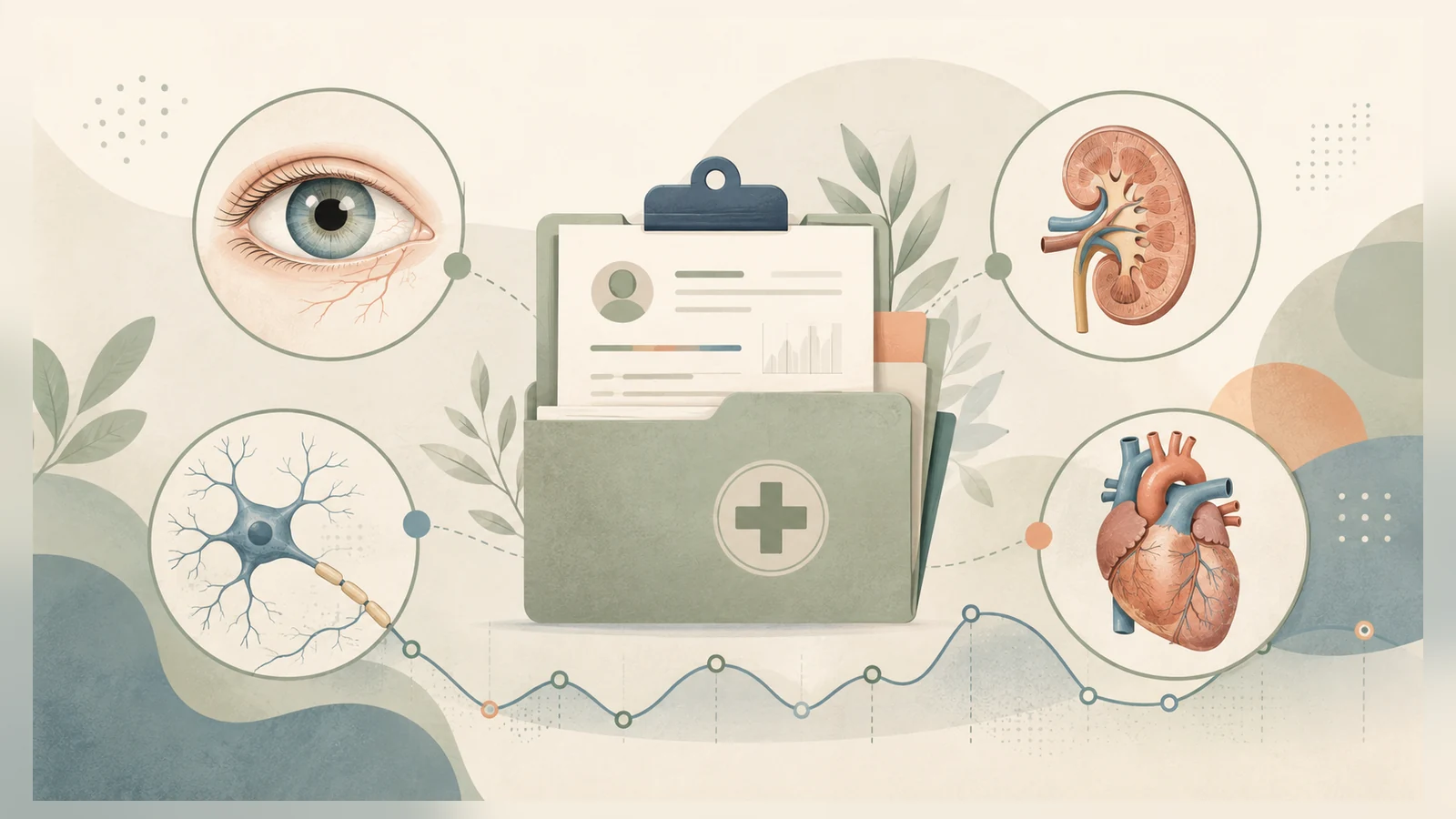
Why does too much sugar in the blood cause harm at all? Put simply, over years excess sugar “gums up” fine structures in vessels and nerves. Two areas are affected: the small and the large blood vessels.
The two groups: small and large vessels
In the small vessels (microvascular), three organs are mainly affected: the eyes (retina, retinopathy), the kidneys (nephropathy) and the nerves (neuropathy, often first in the feet). In the large vessels (macrovascular), the risk rises for heart attack, stroke and circulatory problems in the legs and feet.
The lever: good values work measurably
That good control pays off is impressively documented. In the large UKPDS study, each 1-percentage-point improvement in the long-term marker HbA1c markedly lowered the risk of microvascular complications (on the order of about a third fewer).1 Notable is the so-called legacy effect: early good control keeps having an effect years later. As a rough guide, an HbA1c around 7% applies for many – but the exact target is always set individually.
Detect early: the preventive checks
Many complications develop unnoticed for a long time – which is why regular checks are so valuable: the eyes (retinal examination), the kidneys (urine and blood values such as eGFR) and the feet (skin, sensation, circulation). When changes are found early, a lot can usually be done before symptoms arise.
Key takeaways
- Microvascular: eyes, kidneys, nerves. Macrovascular: heart, brain, feet/legs.
- Good blood-sugar values measurably lower the risk (UKPDS: per 1% lower HbA1c ~ one third fewer microvascular complications).
- Early good control has a lasting effect (legacy effect); HbA1c target is individual (often around 7%).
- For the large vessels, blood pressure, blood lipids and stopping smoking also count.
- Regular checks of eyes, kidneys and feet detect problems early.
Article ID: SWF-W-011Please quote this ID for corrections or additions.
Sources
Sources as of: 21 Jul 2026.
- UKPDS 35: each 1% lower HbA1c markedly reduces microvascular complications; legacy effect. BMJ/PubMed. pubmed.ncbi.nlm.nih.gov (opens in a new window)
- Diabetes complications (micro-/macrovascular) and preventive checks. Diabinfo. diabinfo.de (opens in a new window)
- Standards of care: screening for retinopathy, nephropathy, neuropathy; cardiovascular risk. ADA. diabetesjournals.org (opens in a new window)