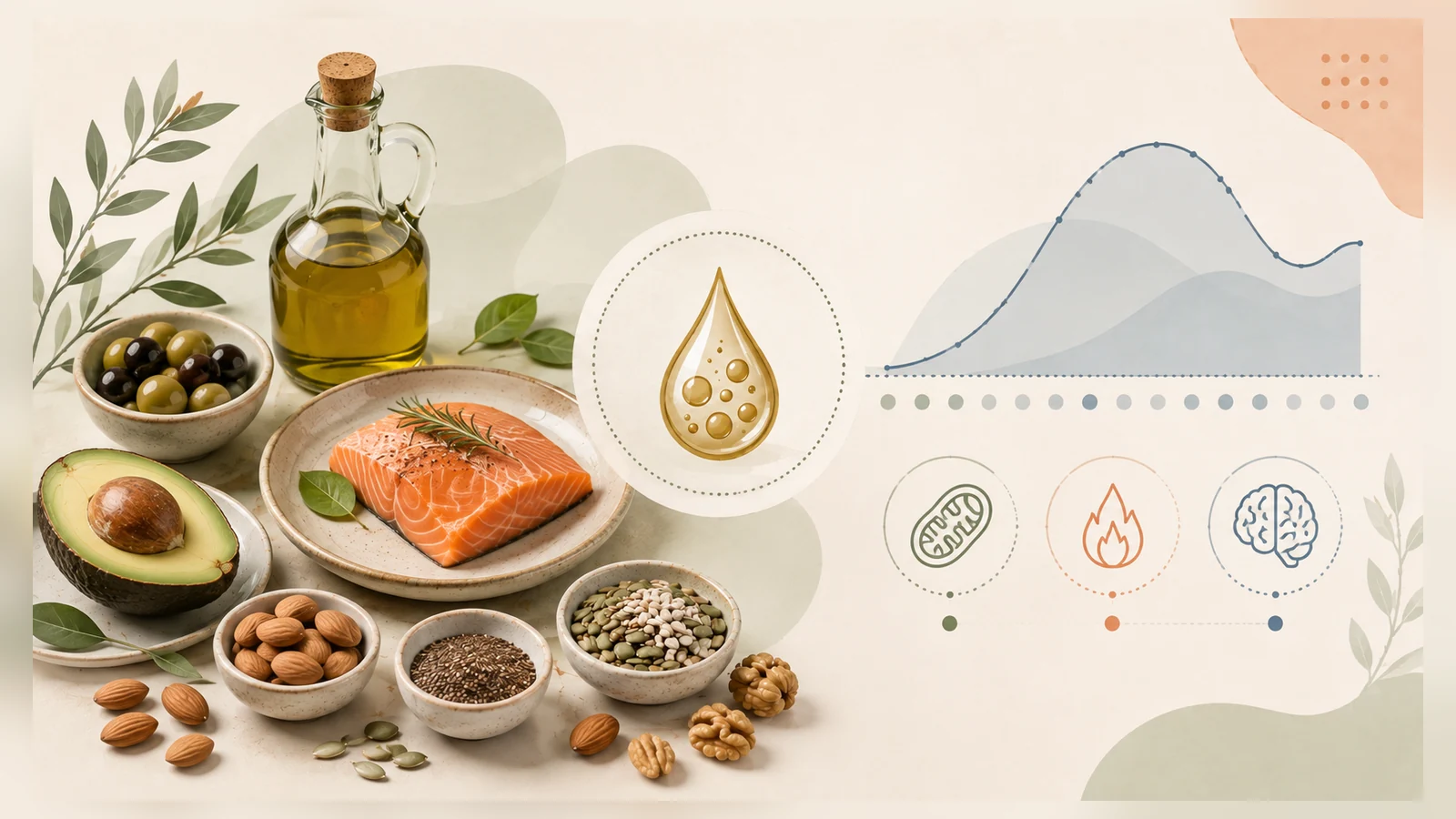
Fat is the macronutrient with the smallest immediate effect on blood sugar: unlike carbohydrates, it delivers no direct glucose. Yet its effect on metabolism is anything but neutral.
Why fat changes the curve
Fat slows gastric emptying. As a result, glucose from the same meal is absorbed more slowly: the blood-sugar curve becomes flatter, the rise starts later and drags out longer.1 With carbohydrate-rich meals, this can soften the spike.2 For people on insulin therapy, this later peak (the so-called “pizza effect”) is worth planning for.
Over the day: too much fat can dampen insulin action
Larger amounts of fat across the day can temporarily worsen insulin sensitivity – via raised free fatty acids in the blood.1 So what matters isn’t only the amount, but above all the type of fat.
Fat quality is decisive
A large meta-analysis of randomised nutrition trials (102 studies, over 4,200 adults) showed: unsaturated fats (especially polyunsaturated, PUFA) in place of carbohydrates or saturated fats improved HbA1c and insulin resistance (HOMA-IR).3 Saturated fat, by contrast, tends to promote insulin resistance.3 Good sources of unsaturated fats are olive oil, nuts, avocado and oily fish.
Key takeaways
- Fat barely raises blood sugar directly but slows absorption.
- Result: a flatter, but later and longer, blood-sugar curve.
- The “pizza effect” matters with insulin therapy.
- Lots of fat across the day can temporarily dampen insulin action.
- Unsaturated fats are more favourable than saturated.
Article ID: SWF-W-010Please quote this ID for corrections or additions.
Sources
Sources as of: 21 Jul 2026.
- Fat slows gastric emptying and flattens the postprandial curve; free fatty acids and insulin sensitivity. Review. pmc.ncbi.nlm.nih.gov (opens in a new window)
- Fat softens the glucose spike of carbohydrate-rich meals. Study. pubmed.ncbi.nlm.nih.gov (opens in a new window)
- 102 RCTs: unsaturated (PUFA) fats vs. carbs/saturated improve HbA1c and HOMA-IR. Meta-analysis, PLOS Medicine. journals.plos.org (opens in a new window)
- Meta-analysis (30 RCTs, 2023): replacing SFA with MUFA/PUFA did not significantly change insulin sensitivity in the short term. Am J Clin Nutr. ajcn.nutrition.org (opens in a new window)