An organ that never quite clocks off
Your brain consumes glucose around the clock. It cannot store it and it cannot pause while you sleep. Roughly speaking, the brain alone draws about 120 grams of sugar from the blood each day – regardless of whether you are eating, fasting, running or dreaming. Red blood cells and parts of the kidney medulla depend on glucose too.
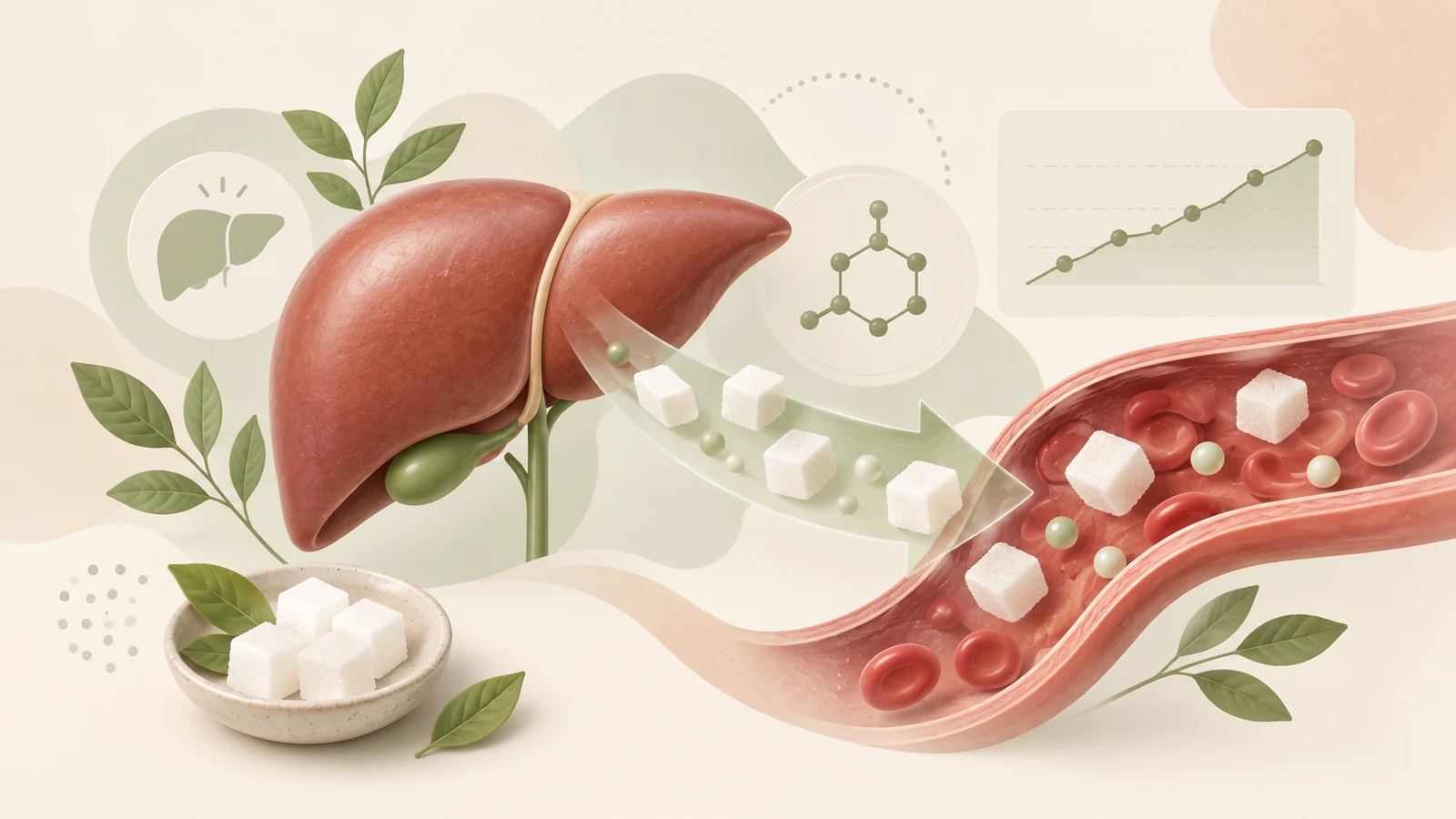
Yet twelve hours often pass between dinner and breakfast. If nothing arrives during that time, the supply still has to run. That is precisely what the liver is for. It is not merely a filter but a warehouse and a production site in one – and it keeps blood sugar within a surprisingly narrow band although nothing is topped up from outside.
Once you have grasped that, many values look different. The raised morning reading is no longer a puzzle. Nor is the rise after a hard training session. And the experience that a low value is sometimes followed by a high one gains an explanation that has nothing to do with discipline.
Two routes by which sugar leaves the liver
The liver has two separate procedures for putting glucose into the blood. They differ in speed, in capacity and in what they consume.
The store: glycogenolysis
After a meal the liver stores surplus glucose in chains, as glycogen. Picture a larder holding about 100 grams of sugar. When blood sugar falls, the liver splits individual glucose molecules off these chains and releases them into the blood. This happens fast, within minutes, which is why it is the first route the body uses.
The catch: the larder is finite. Without resupply the store lasts roughly twelve to twenty-four hours, depending on activity. Fasting overnight draws on it. Training on an empty stomach in the morning draws on it further – and then the second route comes into play.
The new production: gluconeogenesis
When the store runs low, the liver reassembles glucose from building blocks. It uses lactate from muscle metabolism, amino acids from body protein and glycerol released as fat tissue is broken down. The process is slower and energetically expensive, but it can be sustained almost indefinitely. That is why people on hunger strike do not die of hypoglycaemia.
One detail of this route matters for everyday life: amino acids come partly from muscle. A body working for long stretches without carbohydrates and under heavy load potentially draws on its own substance. That is one reason why very long fasted training is not automatically the better choice.
The control loop: brake and accelerator
Whether the liver supplies or stores is not its own decision. It follows two hormones that work against each other – and both come from the same gland, the pancreas.
Insulin is the brake. It rises after eating and tells the liver, in essence: enough is arriving from outside, stop production. At the same time it opens the cells for glucose uptake. Together these lower the value.
Glucagon is the accelerator. It rises when blood sugar falls and instructs the liver to break down glycogen and build glucose anew. It is supported by adrenaline, cortisol and growth hormone – the same hormones that rise under stress and on waking.1
With intact regulation both signals mesh like the accelerator and brake of an experienced driver. The value fluctuates, but within a narrow corridor. What is remarkable is how robust this system normally is: even after several days without food, the blood sugar of a healthy person rarely falls below a range in which the brain remains able to work.
When the liver becomes particularly active
There are four typical situations in which glucose release ramps up. All four make sense – and all four can produce a value that looks inexplicable on the sensor.
| Situation | What the liver does | Why |
|---|---|---|
| Overnight and while fasting | releases glucose continuously | brain and blood cells need supply, nothing arrives from outside |
| In the early morning hours | increases release further | cortisol and growth hormone prepare the body for waking |
| Under exertion | replaces what the muscle consumes | the working muscle draws glucose from the blood |
| When blood sugar falls | releases until the value rises again | protection against hypoglycaemia – this takes priority over everything |
| Under stress | releases additional glucose | adrenaline and cortisol provide energy for a response |
The last row is the one most often overlooked in daily life. An argument, a bad night, an exam or a night-time call-out can raise blood sugar without a single bite involved. Anyone looking only at carbohydrates is searching in the wrong place.
The dawn phenomenon: an alarm clock nobody set
From about three in the morning the body begins preparing to wake. Growth hormone and cortisol rise. Both temporarily reduce insulin action and prompt the liver to release glucose. The result is blood sugar climbing between four and eight – without anything having been eaten.2
This dawn phenomenon is neither an illness nor a fault. It is part of the normal waking programme and happens in everyone. The difference lies in the extent: anyone with an intact insulin response notices nothing, because the brake engages at once. Anyone insulin resistant sees the rise on the sensor.
In the morning two things coincide: the liver is already supplying more, and insulin action is at its weakest point of the day. The same meal and the same exercise session often work quite differently in the evening than at seven in the morning. Comparing a morning protocol with afternoon values therefore means comparing two different starting positions.
What shifts with insulin resistance
With insulin resistance the cells respond more weakly to insulin. For the liver this means concretely: the braking signal arrives, but muffled. It keeps releasing glucose although insulin is in the blood and although the value is not low at all. Technically this is called raised hepatic glucose production – and it explains a large part of the elevated fasting values in type 2 diabetes.5
The asymmetry is what matters: the brake loses effect, the accelerator does not. Glucagon, adrenaline and cortisol carry on working. A system with a weak brake and an intact accelerator tends to overshoot – and that is exactly what many people with CGM observe when a low value is followed by a strikingly high one.
Why a low can turn into a high
When blood sugar falls towards 70 mg/dl, the body reads it as an alarm. Glucagon rises, with a steeper fall adrenaline joins in, and the liver opens the gates. This protective mechanism does not ask how the low value came about. Whether you ate too little or trained too hard makes no difference to it.1
That explains a pattern many find contradictory: you do something that lowers blood sugar – and shortly afterwards a higher value stands on the display than before. The liver has not overreacted; it has done what it is there for. It simply has no way of knowing that a meal is about to arrive or that the fall was intended.
A high value after a low one is often called a „rebound“ in the sense of a Somogyi effect, that is, night-time hyperglycaemia following an unnoticed hypo. That explanation is disputed: newer investigations using continuous monitoring find little research for the classic Somogyi effect, whereas the dawn phenomenon is well documented. That counter-regulation kicks in after a genuine fall is undisputed – that it routinely produces high morning values is not.
What the liver is not
It is tempting to see this organ as an opponent. You work on your values, and the liver ruins them again. That view misleads, and it leads to poor decisions.
Glucose release from the liver is the reason nobody dies of hypoglycaemia in their sleep. It is the reason a person can go several days without food. And it is the reason the brain stays able to work when the rest of the body has long since switched to low power. Treating it as an enemy means fighting a safety system.
A different question is more useful: under what conditions does this system ramp up, and which of those can I influence? Sleep, stress, meal timing and exercise intensity are on that list. The wish that the liver would simply stop is not.
The circuit between muscle and liver
An exchange runs between working muscle and liver that is rarely mentioned, yet it explains precisely why hard exertion has an after-effect. When a muscle works intensely and does not get enough oxygen, it breaks glucose down incompletely. What remains is lactate – the substance colloquially blamed for the burning in your legs.
This lactate does not disappear. It travels through the blood to the liver, which rebuilds glucose from it and returns it to the blood. The muscle can use it again. This circuit is called the Cori cycle, and it is a closed system: what the muscle gives off as lactate comes back as glucose.
For blood sugar this has a practical meaning. An intense session generates a lot of lactate and thereby supplies the liver with plenty of raw material for new production. A calm session generates hardly any, because the muscle works predominantly with oxygen. That is one reason why the intensity of a session determines not only how far the value falls during it, but also how much supply the liver has available afterwards.
When the liver becomes fatty
One point that often plays a role in type 2 diabetes concerns the state of the liver itself. If fat accumulates in the liver cells – so-called fatty liver – its response to insulin deteriorates further. The braking signal then arrives weaker still, and glucose release continues even more stubbornly.
What is remarkable is the direction in which this can resolve. Fat in the liver is mobile: it responds comparatively quickly to a calorie deficit and to movement, often faster than the number on the scales. This is exactly what the remission trials rest on, in which people reached normal fasting values again after substantial weight loss. The reverse does not follow, however: not everyone achieves this, and nobody can say in advance who will.
Alcohol: when the liver switches priorities
There is one situation in which the liver actively throttles its sugar production – and it surprises many people. When alcohol enters the blood, the liver treats it as a priority. Breaking down ethanol takes precedence over almost everything else, because the intermediate acetaldehyde damages cells and has to go quickly.
While the liver is occupied with that, it throttles gluconeogenesis. In other words: the most important protection against hypoglycaemia is temporarily dampened. Alcohol can therefore lower blood sugar with considerable delay, sometimes only ten to twelve hours later, that is, in the middle of the night. Anyone who drinks in the evening and sees an unusually low value in the morning has often experienced exactly that.
This combination deserves particular caution. When a medication lowers blood sugar while the liver’s counter-regulation is throttled, both are missing: the accelerator and the brake on the fall. Anyone taking insulin or sulfonylureas should discuss the handling of alcohol explicitly with their care team.
Three questions that keep coming up
Can I stop the liver releasing sugar?
Not directly, and you should not want to. What can be influenced are the conditions under which it ramps up: sufficient sleep, less stress, moderate rather than extreme peaks of exertion, and insulin action that improves through regular movement. Medicines such as metformin act precisely here – among other things they lower glucose release from the liver. That is a medical decision, not a self-experiment.
Why is my value higher in the morning than after dinner?
Because the night lies between the two measurements, during which the liver supplies continuously, and because from the early morning hours the hormones that prepare waking are added. The comparison deceives: the evening value is a value after food intake, the morning value a value after twelve hours of self-production.
Does a low value during exercise mean I ate too little?
Not necessarily. The working muscle takes up glucose independently of insulin, and if it draws more than the liver supplies at the same time, the value falls – even with normally filled stores. What matters is less whether you ate beforehand than how hard and how long the session was, and what happens afterwards.
What this means in practice
A few conclusions follow from the physiology that hold up in daily life. They do not replace individual advice, but they make sense of what many people see on their sensor.
- A high morning value is rarely a dietary mistake from the night before. More often it is the normal morning glucose release becoming visible when insulin action is weakened.
- Movement works even without insulin. The working muscle takes up glucose via GLUT-4 transporters, independently of the insulin signal.3 It is the most effective lever you hold yourself.
- Intensity has a say. A calm session consumes glucose without triggering the alarm system. A very hard session can do both.
- Protein barely raises the value – but not never. With pronounced insulin resistance, amino acids can deliver glucose with a delay via glucagon.4
- Stress and lack of sleep belong in the calculation. Both raise the value by the same route as a meal, only without calories.
Anyone taking insulin or sulfonylureas starts from a different position: there, counter-regulation cannot always catch a hypo because the medication keeps working. Fasted training, longer gaps between meals and intense sessions belong in a prior conversation with a doctor – not in a decision made after reading an article.
In short
The liver is the only instance in the body that can produce sugar without anyone eating. It does so via a fast store and a slow new production, steered by insulin on one side and glucagon plus stress hormones on the other. With insulin resistance the brake loses force while the accelerator carries on – and that explains both raised fasting values and the experience that a low value can pull a high one after it.
These processes are not a special case and not a personal weakness. They run in everyone. They only become visible once you measure continuously – and then it is worth knowing who is actually at work.
The essentials at a glance
- The liver supplies brain and blood cells with glucose even when nothing is eaten.
- It uses two routes: the fast glycogen store (around 100 grams) and the slower rebuilding from lactate, amino acids and glycerol.
- Insulin brakes the release; glucagon and stress hormones drive it.
- The dawn phenomenon is part of the normal waking programme and happens in everyone – it becomes visible mainly when insulin action is weakened.
- With insulin resistance the brake loses effect while the accelerator stays intact.
- When the value falls towards 70 mg/dl the liver releases glucose – regardless of why it fell.
- Glucose release is a safety system, not an opponent. What can be influenced is above all sleep, stress, timing and exercise intensity.
Sources
Sources as of: 26 Jul 2026.
- Counter-regulation as blood sugar falls: glucagon and adrenaline trigger glucose release from the liver; the mechanism starts within the lower normal range. Review. ncbi.nlm.nih.gov/PMC5375488 (opens in a new window)
- American Diabetes Association: High Morning Blood Glucose – the dawn phenomenon driven by cortisol and growth hormone, independent of food. diabetes.org (opens in a new window)
- Physical activity, GLUT-4 and insulin sensitivity: insulin-independent glucose uptake in muscle, acute during and shortly after a session. PMC (2020). pmc.ncbi.nlm.nih.gov/PMC7235686 (opens in a new window)
- Franz MJ / Nuttall FQ: Dietary Protein and the Blood Glucose Concentration. Diabetes (2013); protein delivers small amounts of glucose with a delay via glucagon and hepatic gluconeogenesis. pmc.ncbi.nlm.nih.gov/PMC3636610 (opens in a new window)
- American Diabetes Association, Standards of Care in Diabetes: pathophysiology of type 2 diabetes, including raised hepatic glucose production as a cause of elevated fasting values. diabetesjournals.org (opens in a new window)