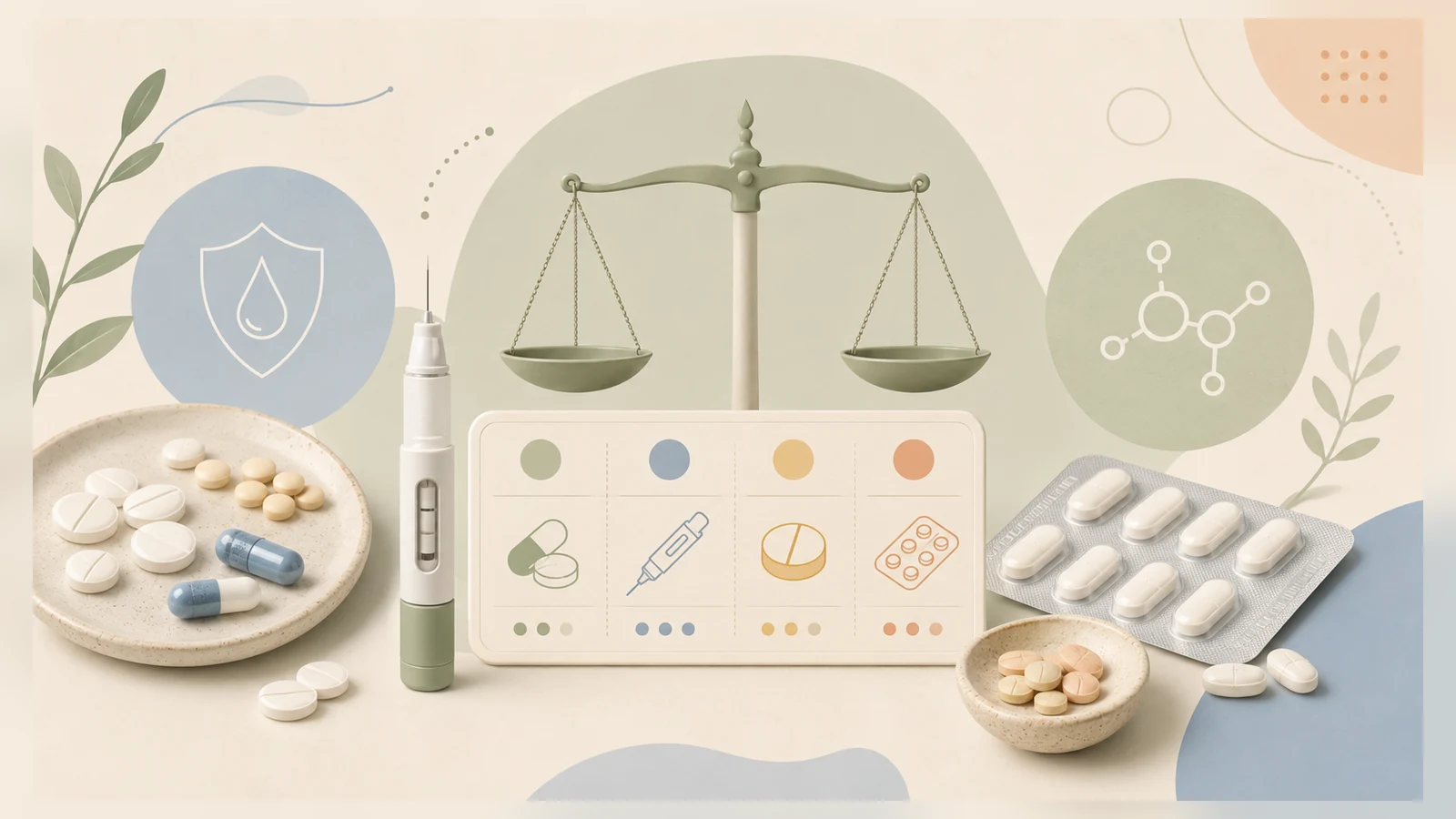
Why there are so many classes
Blood sugar can be influenced in several places: at the liver’s sugar release, at insulin secretion, at insulin action, at sugar excretion through the kidney, or at digestion. Each drug class works at a different point, which is why they can often be sensibly combined.
The classes in detail
Metformin mainly lowers the liver’s sugar release and improves insulin action. In type 2 it’s usually the first medication, well established, and on its own it barely causes hypoglycaemia.
SGLT2 inhibitors cause excess sugar to be excreted via the urine. Beyond blood sugar, several of these agents protected the heart and kidneys in studies, which is why they’re now also used with corresponding comorbidities.
GLP-1 receptor agonists boost insulin secretion after eating, curb appetite and slow gastric emptying. Many people lose weight on them; some agents also showed cardiovascular protection.
DPP-4 inhibitors work on a related pathway to the GLP-1 drugs, usually as a tablet and weight-neutral.
Sulfonylureas directly stimulate the pancreas to release insulin. They work reliably but, unlike most newer agents, can cause hypoglycaemia.
Insulin replaces or supplements the body’s own insulin. In type 1 it’s always necessary; in type 2 it’s used when other agents are no longer enough.
Key takeaways
- Different drug classes act at different points and can often be combined.
- Metformin is usually first choice in type 2.
- SGLT2 inhibitors and GLP-1 receptor agonists can also benefit heart, kidneys and weight.
- Sulfonylureas and insulin can cause hypoglycaemia.
- The choice is always made by the care team – individual and depending on comorbidities.
Article ID: SWF-W-008Please quote this ID for corrections or additions.
Sources
Sources as of: 21 Jul 2026.
- Pharmacological approaches to glycaemic treatment; drug classes and cardiorenal benefits. ADA Standards of Care. diabetesjournals.org (opens in a new window)
- Medications for type 2 diabetes: classes, effects, hypoglycaemia risk. IQWiG / Gesundheitsinformation. gesundheitsinformation.de (opens in a new window)
- Overview of diabetes medications and how they act. Diabinfo. diabinfo.de (opens in a new window)