
I have type 2 diabetes and live without insulin and without diabetes medication. The mechanisms are generally well documented; my numbers and curves are single-case observations (n=1) from my FreeStyle Libre 3. Your response may differ. No promise of cure.
Why movement works so strongly at all
The core is quickly explained: working muscles need energy, and take glucose from the blood. What’s special: during exertion the muscles can take up sugar even without insulin. For this they move a transporter called GLUT4 to the cell surface, entirely independent of how well insulin is currently working.1 That’s exactly why movement is so valuable with insulin resistance: it opens a second route for sugar to get from the blood into the cells.
On top of that comes the long-term effect: regular training makes the cells more sensitive to insulin again. The body needs less of it to do the same job: the baseline load drops. So movement lowers the value short-term and improves the whole regulation long-term.
1. Moderate endurance: my most reliable lowerer
Easy cycling, brisk walking, calm swimming, anything that brings the pulse into a comfortable “I could still hold a conversation” zone (roughly zone 2). For me this is the most reliable way to actively lower blood sugar. At this intensity the muscle continuously burns glucose without the body strongly releasing stress hormones that would counteract it.
How I do it: in the morning I ride 30–45 minutes on the Peloton at a calm intensity. That’s the core of my routine, and in my long-term documentation my pattern shows clearly: moderate endurance reliably lowers for me, while intense effort tends to raise. How a single such session starts on an empty stomach I document in Protein fasting & blood sugar.
If you’re starting out: 20–40 minutes of easy endurance, on as many days of the week as possible. Better frequent and calm than rare and hard. The intensity is right if you could still talk. To begin with, a daily brisk walk is enough: the main thing is regularity.
2. Very intense: can briefly raise the value
This surprises many: after a hard session, intense intervals, maximum effort, blood sugar can briefly rise instead of fall. The reason is stress hormones (adrenaline, cortisol): they signal the liver to release extra glucose into the blood so the muscles have enough fuel under full load. Only afterwards, when the body recovers and refills its stores, does the value fall: often even below the starting point.
I see this biphasic curve (“down first or straight up, then down”) in my data again and again. A Peloton evening swings up and down several times after the sessions for me: here the value stayed within the target range:
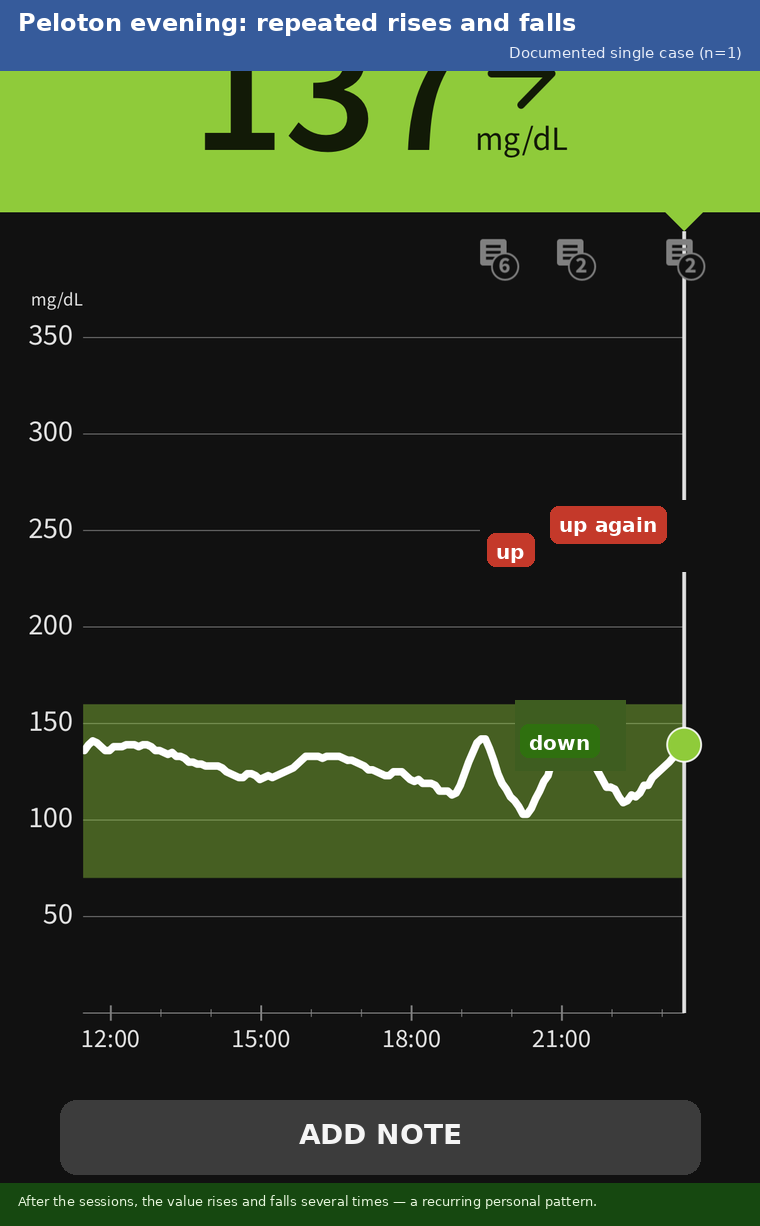
I experience the same principle with stress-intensive firefighting call-outs: even without a bite of food my value rises, purely from the tension and strain. That’s no reason to avoid intense movement: on the contrary, it has its place. You just have to read the short-term rise correctly and not panic. I’ve broken down the full curve in Exercise: down first, then up.
Intensity is valuable for fitness and muscle, butdosed. If your goal is calm morning blood sugar, don’t put hard sessions right before a measurement that worries you. Better measure the curve over 2–3 hours afterwards, then you see the drop, not just the peak.
3. Strength training: the lever for the long game
Strength works less via the single, acute effect, but all the more over time. The reason: muscle is the body’s largest sugar store. The more muscle mass you have, the more storage space for glucose is available, and the better your body responds to insulin. That’s why especially the large muscle groups (legs, back) are so valuable.
How I do it: alongside cycling I go to the weights several times a week, with a rotating split and deliberately an extra leg day, the thighs in particular are decisive for glucose uptake. Strength is the investment you don’t see immediately in the day’s curve, but months later in the HbA1c.
2× per week strength training of the large muscle groups is a realistic, effective starting point, also with your own body weight at home (squats, lunges). It’s not about peak performance, but a regular stimulus for the muscles.
4. Everyday movement: the underrated weapon
You don’t always have to “do sport”. Perhaps the most effective everyday lever is the walk after eating. the research is clear: even 10–15 minutes of walking shortly after the meal noticeably lower the blood-sugar peak, depending on the study and meal by around 20 to 50 percent.2 Three short walks after the main meals measurably improve blood-sugar control across the whole day: partly better than a single longer walk.3
I experience this myself too: during a week when my morning cycling was replaced by about a kilometre of walking (a trade-fair week), my curve still stayed calm: everyday movement catches a lot. The effect comes exactly via the insulin-independent route above: the muscles grab the sugar right as it comes from the meal.
The simplest rule of all: after every larger meal, walk 10–15 minutes: ideally within the first hour. No changing clothes, no equipment. If you sit a lot, add short standing and walking breaks. It’s the lever with the best effort-to-benefit ratio.
How much does it really help? My curve over 90 days
Now to the question that matters most: how strongly can movement really bring the metabolism back? I can’t promise a universal figure, but I can show you my documented values. Over about 90 days of consistent movement (plus adjusted nutrition), the following shifted for me:
And this matches the research: those who move at least 150 minutes per week and lose weight moderately (about 5–7%) can markedly delay or prevent progression to type 2 diabetes.4 Movement is thus one of the most effective non-drug levers we have.
If I were starting from zero
You don’t have to do everything at once. If I were starting from zero today, this would be my order:
- Week 1–2: after every big meal, walk 10–15 minutes. The simplest, most effective first step.
- Week 3–4: add 20–30 minutes of easy endurance on several days (bike, brisk walking).
- From week 5: add strength for the large muscle groups 2× per week.
- Throughout: look at your own CGM curve instead of other people’s promises: it shows you what works for you.
The most important factor isn’t the perfect session, but the regularity. Small things, every day, beat the big effort every two weeks.
For anyone taking insulin or sulfonylureas, exercise can lower blood sugar strongly, also with a delay hours later (risk of hypoglycaemia). Training volume, timing and possible adjustments belong in a conversation with your care team beforehand.
Key takeaways
- Movement opens an insulin-independent route (GLUT4): ideal with insulin resistance.
- Moderate endurance reliably lowers; very intense can briefly raise (then fall).
- Strength training works long-term via more muscle mass and better insulin sensitivity.
- 10–15 min walking after eating lowers the peak by ~20–50%: the best everyday lever.
- My n=1 curve over 90 days: TIR ~66 → 78–80%, avg 139 → 131 mg/dl, HbA1c 5.7%.
- What matters is regularity – and looking at your own CGM curve.
The original measurement record remains unchanged. This section adds only method, sources, limitations and a reproducible follow-up plan.
The central question in this article
The article “Exercise as support: which movement does what for blood sugar” examines which forms of movement may lower, steady or temporarily raise glucose in different time windows. The quality test is not whether one curve creates a compelling story. It is whether the timeline, data source, surrounding circumstances and alternative explanations are documented well enough for readers to separate observation from interpretation.
What the data show — and what they do not
A personal series can show timing and recurring patterns. It cannot by itself prove which physiological mechanism caused the pattern. Direct observation, plausible explanation and open question are therefore separated. Numbers remain linked to unit, time and data source, and missing details are not replaced with guesses.
Reading CGM correctly
Continuous glucose monitoring measures interstitial glucose. During rapid rises or falls, the display may follow blood glucose with a delay. Pressure on the sensor, a newly inserted sensor, hydration and short data gaps can add uncertainty. When a reading does not match symptoms or the situation, a confirmatory measurement may be appropriate depending on the clinical significance.
Technical context: Movement and exercise
Activity can increase glucose uptake by working muscle. At the same time, intense exercise can increase endogenous glucose supply through stress hormones. The direction of the curve therefore cannot be predicted from the word “exercise” alone. Duration, intensity, training status, starting value and the previous meal all matter. For comparisons, intensity should not be described only by a class name or a subjective label. Duration, heart rate, power, pauses, perceived exertion and time of day are more informative. When these data are missing, the interpretation must remain cautious.
Article-specific interpretation
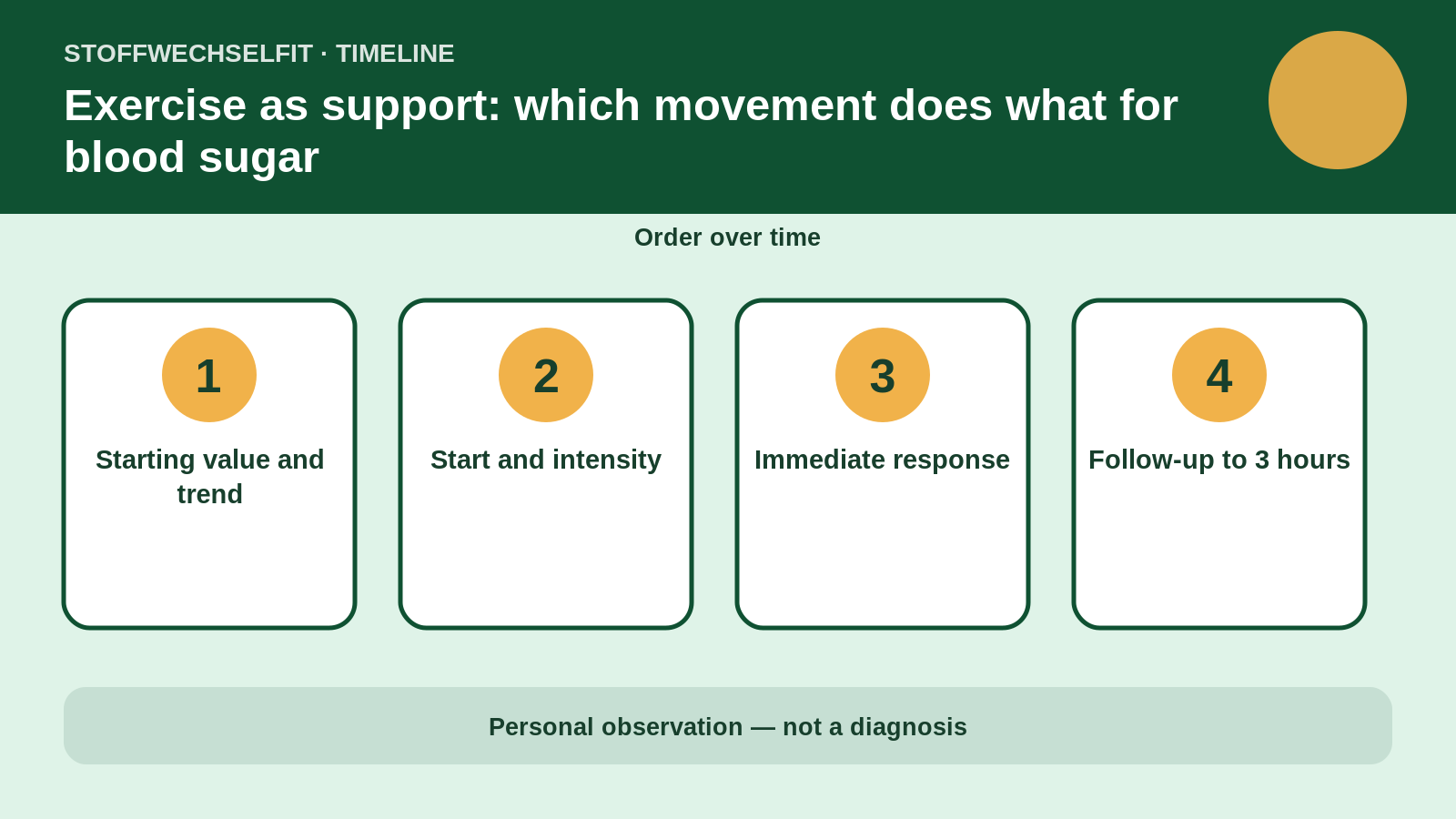
For “Exercise as support: which movement does what for blood sugar”, this means first establishing which of the four phases — Starting value and trend, Start and intensity, Immediate response, Follow-up to 3 hours — are actually documented. A missing phase is not guessed from the curve. This matters especially because which forms of movement may lower, steady or temporarily raise glucose in different time windows. More decimal places do not improve research; more complete context does.
Alternative explanations
The competing influences considered are Exercise intensity, Meal and timing, Liver glucose and stress, Medication and hypo risk. Several can act at once and partly mask one another. No factor is therefore declared causal merely because it occurred close in time. A plausible explanation remains labelled as plausible until a targeted comparison supports it.
Data sheet and provenance
The data sheet for “Exercise as support: which movement does what for blood sugar” records more than the start and peak. It also covers Starting value and trend, Start and intensity, Immediate response and Follow-up to 3 hours. Each section states whether a value was measured directly, read from a screenshot, calculated from raw data or reconstructed from memory. This keeps strong research separate from details that require later verification.
Typical failure modes
Common failure modes in this topic are incomplete portions, an incorrect time origin, events added retrospectively and observation ending too soon. For “Exercise as support: which movement does what for blood sugar”, Exercise intensity and Liver glucose and stress are particularly important competing explanations. A finding is therefore given more weight only when the same direction appears on several sufficiently similar days and counterexamples are documented as well.
Editorial decision
The editorial decision is to keep the personal experience visible without turning it into universal advice. Headline, hero image, alternative text, captions and conclusion must communicate the same uncertainty. When the article contains an open question, it ends with the next testable step — Record the starting value — rather than a claim of effect.
Interpretation matrix
The interpretation matrix for “Exercise as support: which movement does what for blood sugar” assigns every core statement to one of four classes: directly measured, calculated from several readings, physiologically plausible or still open. Direct measurement does not automatically establish causation. A calculated result requires a documented formula and time window. Plausible means consistent with physiology and timing but not isolated in the personal data. Open means that data, repetitions or comparison conditions are missing.
Publication review
Before publication, a final review asks whether the hero image matches the actual message of “Exercise as support: which movement does what for blood sugar”, whether every number can be found in the text, whether units and timing are correct, and whether every image has alternative text and a caption. It also checks that Exercise intensity or Meal and timing has not accidentally been turned into a proven cause. Only then is the article editorially complete.
Reproducible follow-up plan
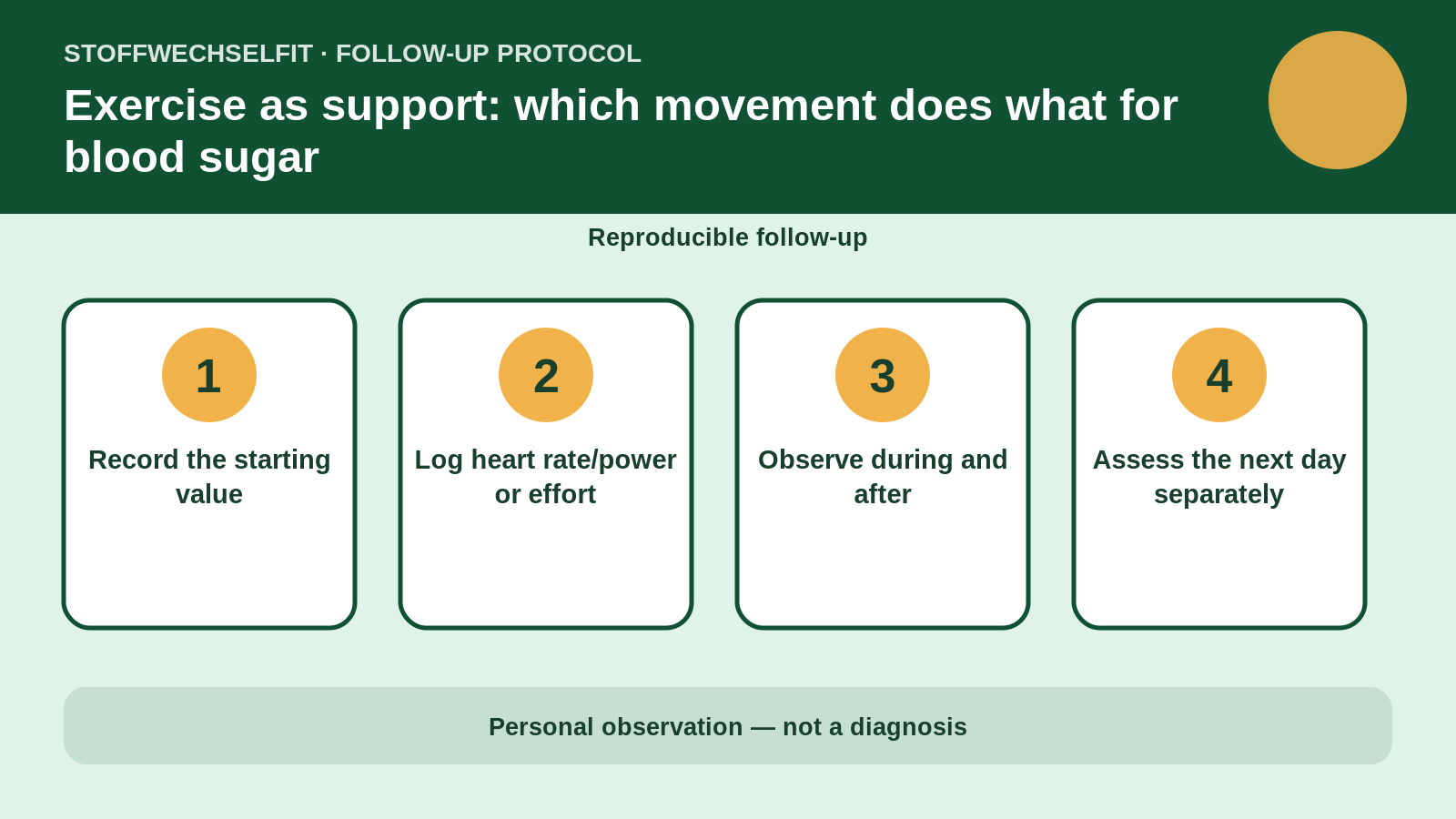
The next useful comparison follows four steps: Record the starting value, Log heart rate/power or effort, Observe during and after, Assess the next day separately. This sequence turns a spontaneous observation into a protocol and reduces the risk of selecting only spectacular days while forgetting ordinary patterns.
What can be transferred
The transferable lesson from “Exercise as support: which movement does what for blood sugar” is therefore not necessarily the exact number. What transfers are the question, the documented conditions and the handling of uncertainty. Other people may respond very differently because of treatment, fitness, insulin sensitivity, digestion or comorbidity.
Comparison rather than snapshot
A credible comparison starts with one clear question and conditions that are as similar as possible. Starting value, trend, time, portion, drinks, activity, sleep, stress and medication all belong in the record. Not every factor can be controlled; the important point is to show differences rather than explain them away afterwards.
State the observation window
Thirty minutes answers a different question from two, four or twelve hours. The article therefore states when observation begins and recognises that mixed meals, alcohol or intense activity can act later. A peak is not interpreted without the pattern before and after it.
Personal readings are not universal limits
Typical guideline targets can provide orientation but require individualisation. Age, comorbidities, pregnancy, medication, hypoglycaemia risk and personal treatment goals change the interpretation. The self-observations shown here do not replace diagnosis or treatment decisions.
Practical safety framework
Marked symptoms, recurrent hypoglycaemia, very high readings, ketones or a pattern that does not fit the situation require clinical assessment rather than another self-experiment. People using insulin or glucose-lowering medication must not derive dose changes or corrections from a blog post.
Further technical limitations
A fall during a session and a later rise can both be plausible. Muscle uptake, digestion, stress responses and liver glucose output do not necessarily peak at the same minute. A complete timeline matters more than the lowest or highest isolated reading. For people using insulin or sulfonylureas, exercise may contribute to hypoglycaemia during activity or several hours later. Medication adjustments require individual clinical guidance. With very high glucose, ketones or marked illness, exercise is not a safe correction strategy.
Questions before drawing a conclusion
- Is the starting value for “Exercise as support: which movement does what for blood sugar” documented with trend and time?
- Are Exercise intensity and Meal and timing described adequately?
- Did observation continue through “Follow-up to 3 hours”?
- Is there a comparison day after “Record the starting value”?
- Is each statement clearly labelled as personal, plausible or generally established?
Sources and context
- American Diabetes Association: Standards of Care in Diabetes—2026, health behaviours and exercise
- American Diabetes Association: Standards of Care in Diabetes—2026, glycaemic goals
- American Diabetes Association: Standards of Care in Diabetes—2026, diabetes technology
- NIDDK: Healthy Living with Diabetes
- WHO: Healthy diet
Medical notice: This article explains a personal observation and general context. It does not replace diagnosis, treatment adjustment or emergency care.
Article ID: SWF-W-024Please quote this ID for corrections or additions.
Sources
Sources as of: 21 Jul 2026.
- Muscle glucose uptake via GLUT4 during exercise is partly insulin-independent. Reference. pmc.ncbi.nlm.nih.gov (opens in a new window)
- Short post-meal walks lower the glucose peak (~20–50%). Study. pmc.ncbi.nlm.nih.gov (opens in a new window)
- Three short post-meal walks beat one longer walk for daily control. Study. pubmed.ncbi.nlm.nih.gov (opens in a new window)
- ~150 min/week activity + 5–7% weight loss markedly delays/prevents progression (DPP). Reference. pmc.ncbi.nlm.nih.gov (opens in a new window)